
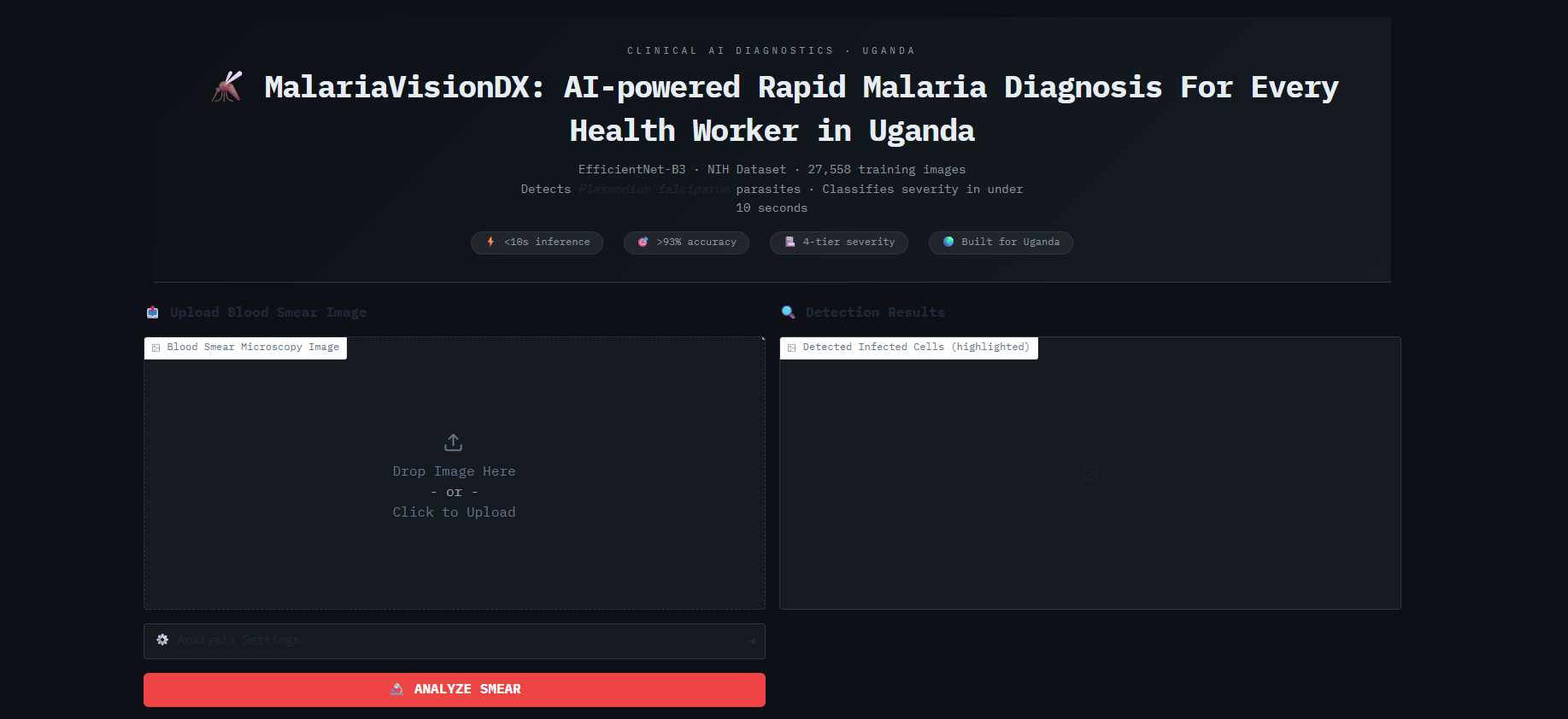
A team of young innovators from Lira Town College has developed MalariaVisionDx, an artificial-intelligence-powered platform designed to analyse microscope blood-smear images and support faster malaria screening.
The students developed the solution in response to a major healthcare challenge: many rural health facilities have limited access to trained laboratory specialists, yet timely malaria testing is essential for ensuring that patients receive appropriate care.
According to the project presentation, MalariaVisionDx aims to reduce the time required to analyse a blood-smear image from nearly an hour to approximately 10 seconds. The team reports that its experimental model achieved more than 96 per cent accuracy during development.
When Delayed Diagnosis Becomes Dangerous
Traditional microscopy requires a trained laboratory professional to examine a blood slide carefully and identify malaria parasites among many blood cells.
The process requires time, concentration, functioning laboratory equipment and specialised skills. In facilities where laboratory personnel are unavailable or overwhelmed, patients may experience long delays before receiving results.
The Lira Town College innovators identified this diagnostic gap as a problem that artificial intelligence could help address.
Their vision is not to remove health professionals from the process, but to develop a digital support tool that could help trained health workers analyse blood-smear images more quickly, especially in underserved communities.
How MalariaVisionDx Works
The platform follows a simple four-stage process.
1. Capture
A health worker takes a photograph of a prepared microscope blood-smear image using a smartphone camera.
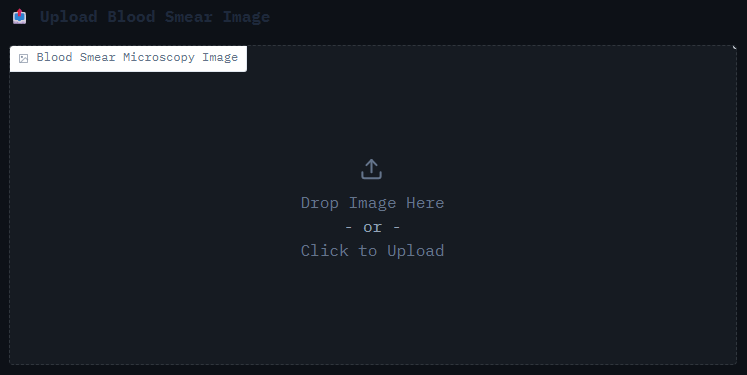
2. Upload
The image is uploaded to the MalariaVisionDx web platform through a browser.
3. Analyse
The artificial-intelligence model examines the image, identifies areas that may contain malaria-infected cells and estimates the proportion of affected cells.
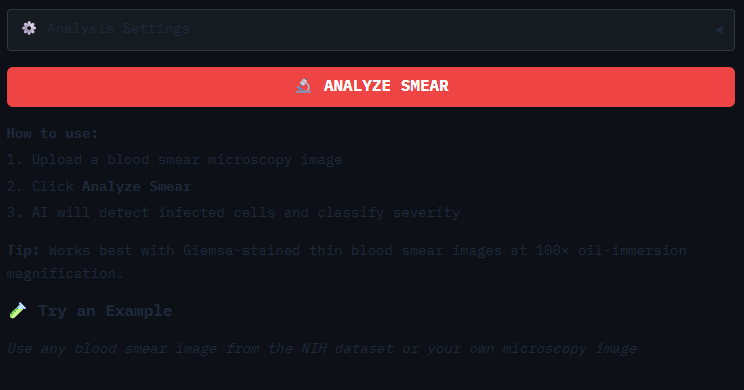
4. Display Results
The platform presents an AI-generated analysis and proposed severity category for review by an appropriately trained health professional.
The project presentation describes the system as a combination of computer vision, deep learning, image processing and a browser-based interface.
The Technology Behind the Platform
The students report that they trained the model using 27,558 blood-cell images from a publicly available National Institutes of Health malaria dataset.
They used EfficientNetB3, a deep-learning image-classification architecture, together with transfer learning. The model was first trained on selected layers before additional layers were fine-tuned to improve its performance.
A sliding-window image-processing method was then used to examine different sections of a blood-smear image, identify suspected infected-cell regions and estimate parasitaemia.
The application was developed using technologies that include:
- TensorFlow
- EfficientNetB3
- OpenCV
- Gradio
- Google Colab
- Hugging Face Spaces
- Computer-vision techniques
According to the students, the prototype was built and deployed using free datasets, open-source software and no-cost development platforms.
Built for Health Workers in Underserved Communities
MalariaVisionDx is intended to support people and facilities that may face limited laboratory capacity, including:
- Community health workers
- Nurses and clinical officers
- Rural health facilities
- District health centres
- Children below five years
- Pregnant mothers
- Public-health programmes
- Organisations working to control malaria
The proposed browser-based platform does not require users to install a large computer program. This could make it easier to access through smartphones and computers already available within some health facilities.
However, dependable internet access would still be necessary for the current online version.
A Zero-Cost Student Innovation
One of the most remarkable aspects of MalariaVisionDx is the students’ use of freely available digital resources.
The project team reports that the dataset, software libraries, model-training environment, application framework and initial hosting services were accessed without financial cost.
This does not mean that a national clinical deployment would have no costs. Real-world implementation would require rigorous testing, secure data management, healthcare-system integration, user training, technical support, regulatory review and long-term infrastructure.
Nevertheless, the prototype demonstrates how students can use open-source technology to investigate complex national challenges without waiting for expensive equipment or a large development budget.
Potential Impact of the Innovation
With further research and professional validation, AI-assisted microscopy could help health workers:
- Analyse blood-smear images more efficiently
- Prioritise cases requiring urgent professional review
- Reduce delays in facilities with limited laboratory capacity
- Strengthen digital-health skills among frontline workers
- Support malaria surveillance and research
- Extend specialist knowledge to underserved communities
The platform could also encourage greater collaboration between schools, universities, technology organisations, medical researchers and public-health institutions.
Important Need for Clinical Validation
MalariaVisionDx is a promising student-developed prototype, but accuracy reported during model development does not automatically make an application ready for independent clinical use.
Before such a tool could be used to guide patient care, it would require independent clinical evaluation using representative local data, approval from the relevant health and regulatory authorities, strong patient-data safeguards and supervision by qualified medical professionals.
AI-generated results should not replace a trained healthcare professional or an approved malaria-testing procedure.
The safest pathway is to develop MalariaVisionDx as a decision-support and research tool while qualified medical experts assess its accuracy, limitations and appropriate role in healthcare.
Future Plans: From Malaria to Wider Blood Analysis
The Lira Town College team has ambitious plans for the future of the project.
These include:
- Developing an offline Android application
- Expanding the system to support facilities with poor connectivity
- Investigating detection of anaemia, tuberculosis and sickle-cell-related abnormalities
- Integrating AI into affordable digital microscopes
- Working toward possible collaboration with health authorities
- Improving the model using carefully collected and ethically managed local data
These future stages would require specialised medical partnerships, additional datasets and extensive laboratory and clinical testing.
Young Innovators Taking on a National Challenge
MalariaVisionDx demonstrates what can happen when students are encouraged to combine computer science with real community problems.
The learners did not develop a simple demonstration with no practical purpose. They attempted to address a complex challenge affecting healthcare delivery across Uganda and other malaria-endemic regions.
Their innovation brings together artificial intelligence, public health, microscopy, software development and social responsibility.
Whether MalariaVisionDx eventually becomes a clinical support platform, a research project or a foundation for future digital-health innovations, the work already carries an important message:
Ugandan students are not only learning how technology works—they are learning how to use it to confront some of society’s greatest challenges.


Leave a Reply
You must be logged in to post a comment.