A team of Senior Four ICT students from St. Mary’s College Rushoroza has developed Deglecy, an innovative online learning platform designed to provide learners with personalised academic support, organised educational content and easier access to digital learning resources.
The platform was presented by Kanyesigye Johanan Ibzan, Agaba Samuel, Rwego Edward and Aheebwe Ekitinisa as a student science fair project under the theme:
“Empowering Every Learner Through AI.”
Responding to Challenges Affecting Learners
The student innovators developed Deglecy after observing several challenges that affect learners both inside and outside the classroom.
Teachers may not always be available when students need additional explanations. Some learners also find it difficult to understand complicated concepts from written notes alone, while quality revision materials may be scattered across different platforms.
Private tutoring can be too expensive for many families, and limited access to academic support may cause learners to lose interest or perform below their potential.
Deglecy was therefore designed to bring tutoring, structured course content and learning materials together on one platform.
What Is Deglecy?
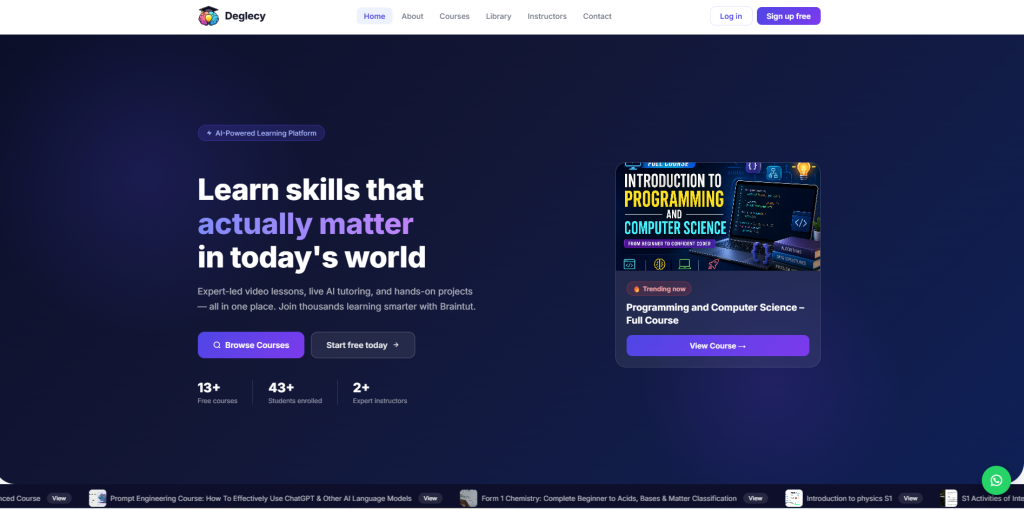
Deglecy is an AI-supported online learning platform that aims to provide personalised educational experiences through three main services:
AI Tutors: Learners can ask academic questions and receive step-by-step explanations, examples and guidance.
Course Playlists: Educational content can be organised into structured learning sequences, helping learners study topics in a logical order.
Digital Resource Store: Learners and teachers can access authorised notes, revision resources, past papers and other educational materials from one location.
Rather than simply presenting static content, the platform is designed to help learners interact with educational material and obtain additional explanations when they encounter difficult concepts.
How the Platform Was Developed
The student team followed a six-stage development process.
They began by identifying challenges through observation and personal experience. They then designed the major platform features, including learner accounts, course playlists, an AI tutor and a digital resource section.
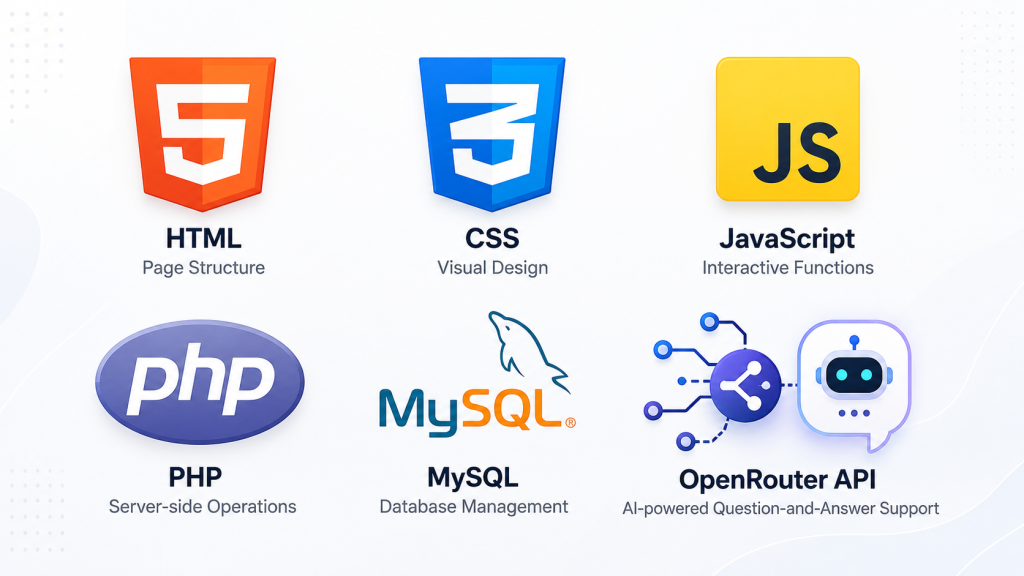
The platform was developed using:
- HTML for page structure;
- CSS for visual design;
- JavaScript for interactive functions;
- PHP for server-side operations;
- MySQL for database management;
- and the OpenRouter API for AI-powered question-and-answer support.
The team tested the platform’s functionality, navigation, responsiveness and the quality of its AI-supported answers. Improvements were then made using feedback received from student users.
AI-Powered Academic Support
Deglecy’s AI component is intended to help learners obtain explanations when a teacher or tutor is not immediately available.
Learners can enter questions using ordinary language and receive:
- step-by-step explanations;
- immediate responses;
- real-life examples;
- and guidance based on the question asked.
The platform is not intended to replace teachers. Instead, it can serve as an additional learning-support tool that helps students revise, practise and better understand challenging topics.
Teachers remain important in verifying information, guiding learners and ensuring that AI tools are used responsibly.
Who Can Use Deglecy?
The platform has been designed to support different members of the education community.
Secondary school students can use it for revision and examination preparation.
Primary school learners can receive homework support and simplified explanations.
Teachers can organise and share approved educational resources.
Parents could use future monitoring features to follow their children’s learning progress.
Schools and other institutions could use the platform to support digital and distance learning.
Advantages of the Platform
Deglecy has the potential to:
- provide academic assistance beyond normal classroom hours;
- support self-paced learning;
- reduce dependence on expensive private tutoring;
- organise different learning resources in one place;
- make difficult concepts easier to understand;
- and expand access to digital educational support.
The students also identified important limitations. The current platform requires an internet connection and access to a digital device. AI-generated answers may sometimes be incomplete or inaccurate and therefore require continuous improvement and responsible supervision.
Future Development Plans
The Deglecy team has outlined a five-phase roadmap for improving the platform.
The first phase will involve developing Android and iOS mobile applications so that learners can access the platform more easily.
The second phase will introduce Ugandan languages such as Luganda and Runyankole, making the platform more inclusive and accessible.
The third phase will focus on an offline mode for learners living in areas with limited or expensive internet connectivity.
The fourth phase will introduce advanced personalisation, learning analytics and adaptive assessments.
The fifth phase will explore integration with school-management systems.
Other important future improvements should include stronger learner-data protection, teacher-controlled content, parental safeguards, curriculum alignment and methods for checking the accuracy of AI-generated answers.
A Strong Example of Student-Led Innovation
Deglecy demonstrates how students can move beyond consuming technology and begin developing practical digital solutions for challenges within education.
Through research, programming, database development, artificial intelligence integration, testing and teamwork, the learners have created a promising foundation for a platform that could support students, teachers, parents and educational institutions.
The project also highlights the importance of school ICT programmes in giving learners opportunities to experiment, solve problems and build technology that responds to local needs.
Congratulations to Kanyesigye Johanan Ibzan, Agaba Samuel, Rwego Edward, Aheebwe Ekitinisa, their teachers and the administration of St. Mary’s College Rushoroza for supporting student innovation.
With continued mentorship, user testing and responsible development, Deglecy could grow into a valuable educational platform that helps more learners access organised, interactive and affordable academic support.



Leave a Reply
You must be logged in to post a comment.