
St. Maria Goretti Katende Students Present a Smart Mobility Innovation
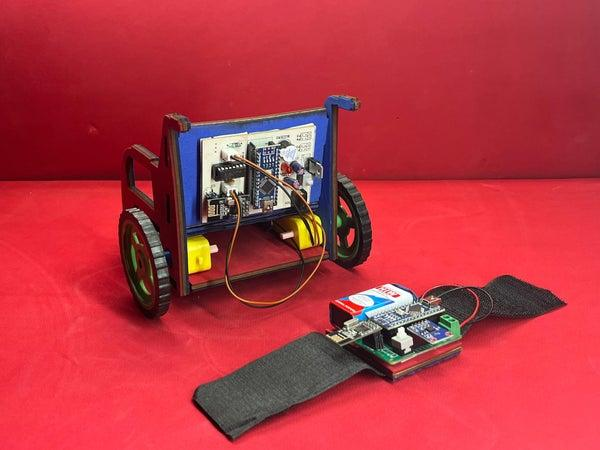
A team of young innovators from St. Maria Goretti Katende Senior Secondary School has developed a Smart Wireless Hand-Gesture-Controlled Wheelchair, demonstrating how student-led science and technology can be applied to solve real challenges affecting communities.
The project was prepared for the NCC 2026 Regional Secondary Schools’ ICT Club Competition and presented by Zalwango Anitah, Namugwanya Sonia, Masanja Travor and Kakama Anthony.
Their innovation addresses mobility challenges experienced by people with physical disabilities, particularly those who may find it difficult to operate manual wheelchairs or who depend heavily on caregivers for movement.
Addressing a Real Community Challenge
For many people with physical disabilities, mobility can be limited by the physical effort required to operate a manual wheelchair. Smart and motorised mobility devices may also be too expensive or unavailable, especially within low-income communities.
This can affect a person’s independence, access to education, participation in community activities and ability to complete everyday tasks.
The student innovators therefore set out to design a solution that could make wheelchair movement easier, more independent and more responsive.
How the Gesture-Controlled Wheelchair Works
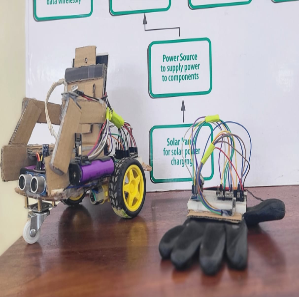
The system is divided into two major units:
- a hand-gesture transmitter unit;
- and a wheelchair control unit.
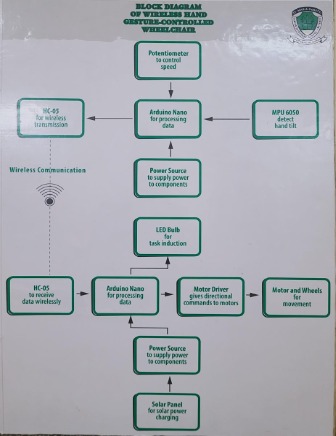
The user wears or holds the gesture-control device. An MPU6050 motion sensor detects the direction and movement of the user’s hand.
An Arduino microcontroller interprets the gesture and converts it into a movement command. The command is then transmitted wirelessly through nRF24L01 communication modules to another Arduino installed on the wheelchair.
The receiving unit sends the appropriate signal to a motor driver, which controls the wheelchair motors.
Through different hand movements, the wheelchair can be instructed to move:
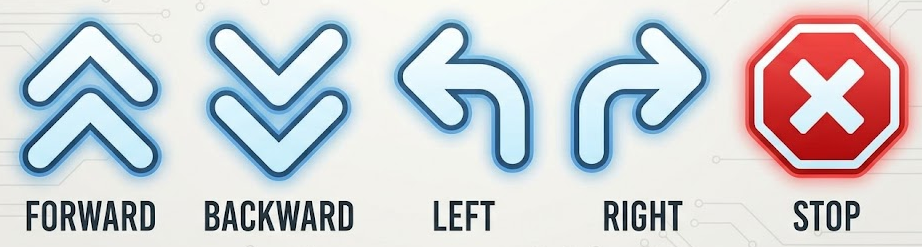
The presentation reports that the developed prototype successfully detected hand gestures and produced reliable wireless communication and motor response.
Combining Electronics, Programming and Human-Centred Design
The project brings together several important areas of learning, including:
- electronic circuit design;
- sensor technology;
- Arduino programming;
- wireless communication;
- motor control;
- prototype construction;
- testing and troubleshooting;
- and assistive technology.
Rather than learning these concepts only in the classroom, the students applied them to a practical solution that could improve the quality of life for people with mobility difficulties.
The project therefore demonstrates the important role of school ICT Clubs in helping learners move from theoretical knowledge to research, experimentation, teamwork and community-centred innovation.
Expected Social Impact
A well-developed gesture-controlled wheelchair could provide several benefits to people with physical disabilities.
It could reduce dependence on caregivers, make movement easier and support greater participation in school, work and community life.
The innovation also promotes dignity by giving users more direct control over their movement.
Although the current model is a prototype, it provides a strong foundation for further development, testing and collaboration with engineers, health professionals, disability organisations and potential users.
Challenges Experienced by the Team
During the development of the prototype, the student innovators experienced several challenges, including:
- limited financial and technical resources;
- calibrating the motion sensor;
- maintaining stable wireless communication;
- integrating several electronic components;
- and achieving consistent motor response.
These challenges provided valuable learning opportunities. The students had to test the system, identify faults, adjust the programming and improve the interaction between the different components.
Future Improvements
The team plans to improve the project by introducing more advanced gesture recognition, increasing the wireless communication range and refining the design for wider accessibility.
Other valuable future improvements could include:
- obstacle-detection sensors;
- an emergency-stop button;
- automatic braking when communication is lost;
- speed-control settings;
- battery-level monitoring;
- stronger and lighter construction materials;
- voice-control options;
- and testing with intended users under professional supervision.
The team also hopes that future development could make the technology suitable for affordable local production.
Celebrating Student Innovation
The Smart Wireless Hand-Gesture-Controlled Wheelchair demonstrates what learners can achieve when they are given opportunities to identify problems, conduct research, build prototypes and test their ideas.
The project is not only an electronics demonstration. It represents creativity, empathy, teamwork and the determination of young people to use technology for social good.
Through initiatives such as the Secondary Schools’ ICT Club Competition, learners are being encouraged to become creators of technology and practical solutions rather than remaining only consumers of digital products.
Congratulations to Zalwango Anitah, Namugwanya Sonia, Masanja Travor, Kakama Anthony, their ICT Club patron, school administration and the entire St. Maria Goretti Katende Senior Secondary School community for advancing student-led innovation.


Leave a Reply
You must be logged in to post a comment.