
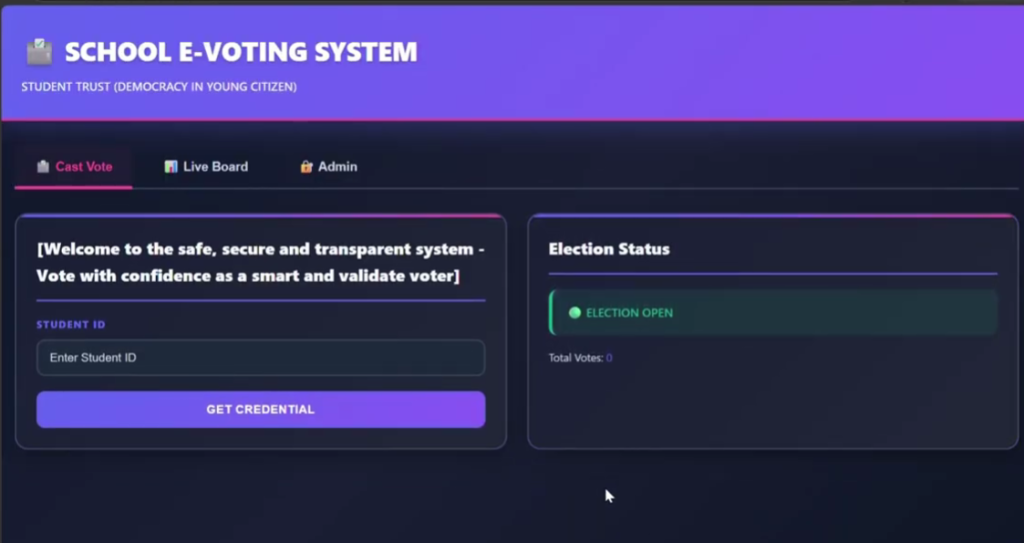
Students of St. Mary Assumpta Girls Secondary School have developed an innovative electronic voting system designed to make school elections more secure, transparent, accessible and efficient.
The project was developed for the NCC 2026 Secondary Schools’ ICT Club Competition by a team comprising Eimani Gladys, Vunzua Harriet, Munduru Consulate and Peace George.
The students identified weaknesses in traditional school-election processes and used their digital skills to design a system that could help schools conduct credible elections while giving learners a meaningful opportunity to choose their leaders.
Addressing Challenges in Traditional School Elections
Voting is an important part of democracy because it allows people to freely choose their preferred leaders and participate in decision-making.
However, traditional voting methods can be affected by several challenges, including:
- Long queues during elections
- Human errors in counting and recording votes
- Vote manipulation and election rigging
- Corruption and electoral malpractice
- Lack of transparency in announcing results
- Appointment of student leaders without consulting learners
- Delays in calculating and communicating results
- Reduced trust in school leadership processes
In some schools, administrators may appoint student leaders without allowing learners to vote. This can deny students an opportunity to exercise democratic participation and may create dissatisfaction among the school community.
The students therefore proposed a digital solution that could protect the integrity of school elections while making the voting process easier to manage.
A Secure and Transparent Digital Solution
The proposed E-Voting System provides a user-friendly platform through which registered voters can securely cast their votes.
The system is intended to reduce election malpractice by introducing stronger voter authentication, encrypted vote transmission, secure storage and automatic vote counting.
It also protects voter anonymity, ensuring that an individual’s choice remains private while allowing election administrators to verify that the election was properly conducted.
Through the platform, schools can conduct elections more efficiently without relying entirely on paper ballots and manual counting.
How the E-Voting System Works
The system contains four major components.
1. Voter Interface
The voter interface provides registered learners with a simple and easy-to-use platform for casting their votes.
Voters can view the available candidates, select their preferred candidate and securely submit their vote.
2. Election Administrator Dashboard
The administrator dashboard allows authorised election officials to manage and supervise the election.
Administrators can:
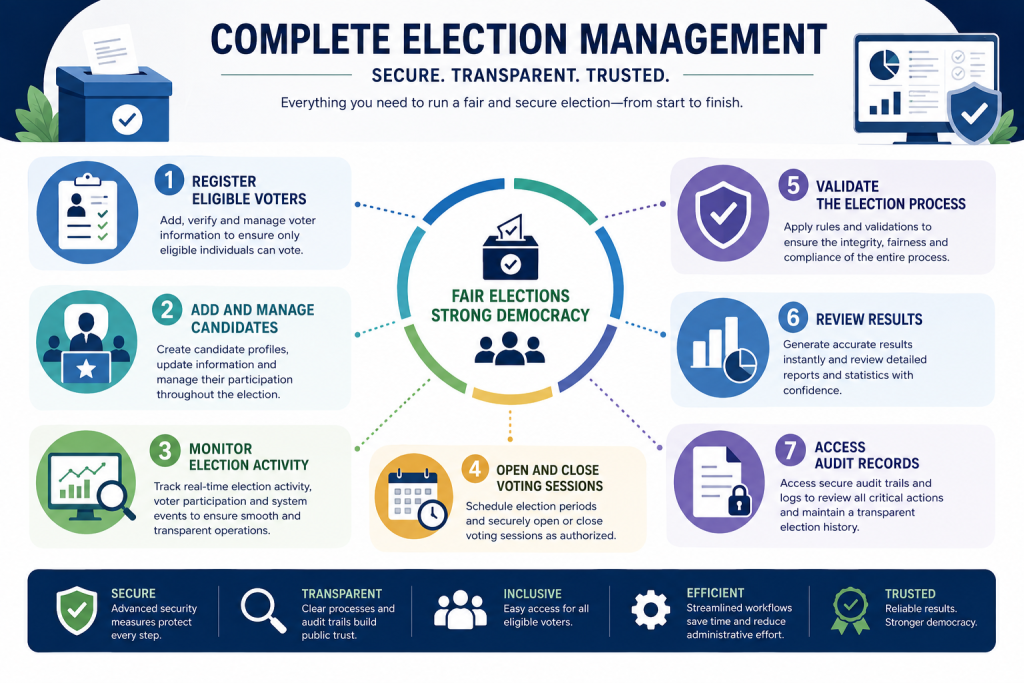
3. Secure Backend Database
The backend database stores voter information, candidate details, election records and final results.
Security controls are incorporated to prevent unauthorised access, vote duplication and manipulation of election data.
4. Live Results Interface
The live interface enables authorised users and members of the school community to follow the progress of an election.
It can provide real-time updates and display verified results after the voting process has been completed.
System Development and Testing
The students followed several stages while developing the platform.
They began by designing the system architecture, including the user interface, database structure and communication between different parts of the application.
The front end was designed to be responsive, accessible and simple enough for learners to use without requiring advanced technical knowledge.
The backend was developed to handle voter authentication, vote submission, candidate management and automatic calculation of results.
Security measures such as encryption and secure communication protocols were introduced to protect data and maintain the integrity of the voting process.
The prototype was also subjected to unit testing, integration testing and user-acceptance testing. These tests helped the team identify technical problems, correct errors and improve the reliability of the system.
Results Achieved
The prototype demonstrated several important capabilities.
Multi-factor authentication helped ensure that only eligible and registered voters could participate in the election.
Votes were encrypted, anonymised and securely stored, reducing the risks of tampering, duplication and unauthorised access.
Automatic real-time tallying enabled the platform to produce fast and accurate election results.
The system also generated audit logs that administrators could use to monitor and validate the different stages of the election.
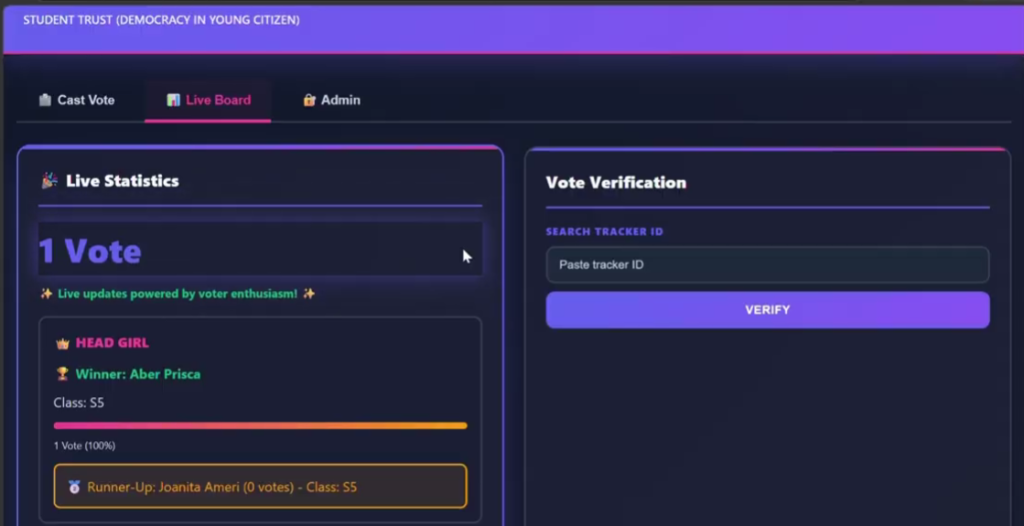
These features demonstrated how digital technology can strengthen transparency and accountability in school elections.
Challenges Encountered
The team encountered several challenges during the development of the system.
One of the main concerns was verifying voters accurately while preventing unauthorised people from participating. The team addressed this by introducing multi-factor authentication and encrypted communication channels.
Maintaining voter anonymity while still providing a way to verify the election was another technical challenge. The students responded by revising and testing different sections of their code.
Network availability was also identified as a potential challenge, particularly in schools with unreliable internet connections.
These challenges provided valuable learning opportunities and helped the students understand the importance of security, accessibility and reliability in digital systems.
Potential Impact on Schools
- The E-Voting System could create several benefits for schools.
Enhanced Security
- Authentication, encryption and secure data storage can help protect elections against fraud, vote duplication and unauthorised interference.
Improved Transparency
- Automatic vote counting and audit logs can make the election process easier to verify and understand.
Greater Efficiency
- The system can reduce long queues, paperwork and the amount of time required to manually count votes.
Increased Accessibility
- Registered voters can use a simple digital interface to participate in elections, including from authorised locations outside the traditional polling station.
Scalability
- Although the prototype focuses on school elections, it could be improved and adapted for larger institutions and community organisations.
Learner Participation
- The project encourages learners to understand democracy, leadership, accountability and responsible participation in school governance.
Plans for Future Development
The students propose several improvements for the future.
The platform could be aligned with appropriate legal, institutional and data-protection requirements before being deployed for larger elections.
Accessibility could be improved by introducing:
- Multilingual support
- Voice-guided voting
- Features for visually impaired voters
- Improved mobile-device compatibility
- Offline or low-bandwidth voting options
- Stronger reporting and election-analysis tools
The system could also be expanded to support elections involving larger numbers of voters while maintaining security, speed and reliability.
Supporting Sustainable Development
The project contributes to the objectives of the United Nations Sustainable Development Goals.
It supports SDG 16: Peace, Justice and Strong Institutions by promoting transparent, accountable and participatory decision-making.
It also supports SDG 9: Industry, Innovation and Infrastructure by encouraging young people to use technology and innovation to address real challenges within their schools and communities.
Young Innovators Solving Real School Challenges
The E-Voting System developed by the students of St. Mary Assumpta Girls Secondary School demonstrates the value of school ICT clubs in nurturing creativity, teamwork, critical thinking and practical problem-solving.
Rather than studying technology only in theory, the learners identified a real problem and designed a solution that could improve democratic participation in schools.
With continued mentorship, testing and institutional support, the project has the potential to become a practical platform for conducting secure and transparent school elections.






Leave a Reply
You must be logged in to post a comment.