IN THIS LESSON, YOU WILL:
✔ Learn about mobile phone features that can support your solution
✔ Understand the difference between a mobile app and a web app
✔ Learn how Artificial Intelligence can help solve problems
✔ Identify examples of AI around you
✔ Reflect on ethical technology use
PART 1: FEATURES OF A MOBILE DEVICE
A mobile phone is more than just a calling device.
It contains powerful tools (called sensors and components) that you can use in your app.
1️⃣ Camera & Microphone
Used for:
-
Taking pictures
-
Recording videos
-
Capturing voice
Uganda Example:
If your problem is poor waste management in town, users can take photos of garbage piles and upload them.
If your problem is bullying, students can record anonymous voice complaints.
2️⃣ GPS (Location Tracking)
Used for:
-
Finding physical location
-
Mapping services
Uganda Example:
An app that helps boda riders avoid accident-prone areas in Kampala.
Or an app that maps broken boreholes in rural areas.
3️⃣ Internet Connectivity
Used for:
-
Sending and receiving data
-
Updating information in real-time
Uganda Example:
Farmers checking daily produce prices in Mbale or Gulu markets.
4️⃣ Storage
Used for:
-
Saving user preferences
-
Offline data access
Uganda Example:
An offline revision app for students in rural areas with limited internet.
5️⃣ Accelerometer & Motion Sensors
Used for:
-
Detecting movement
-
Measuring speed
Uganda Example:
Fitness or sports performance tracking app for school athletes.
🔹 PART 2: MOBILE APP vs WEB APP
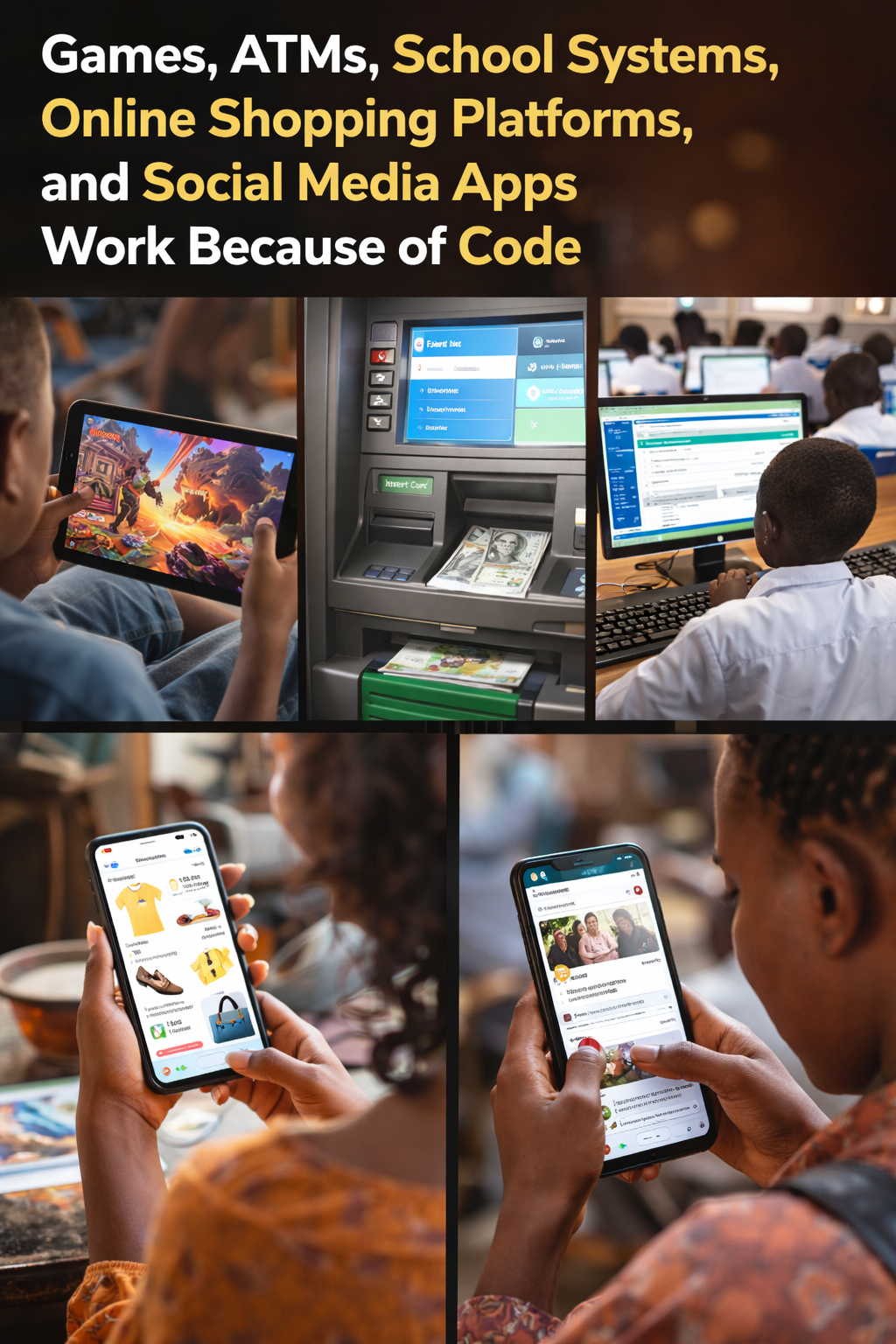
You must choose the correct type of application.
📱 Mobile App
-
Installed on phone
-
Works offline (mostly)
-
Can access camera, GPS, sensors
-
Built for Android or iOS
Example in Uganda:
Mobile money apps
Offline learning apps
Health reporting tools
If using MIT App Inventor → You are building a mobile app.
🌐 Web App
-
Runs in browser
-
Requires internet
-
Works on any device
-
Built with HTML, CSS, JavaScript
Example in Uganda:
School result portals
Online job platforms
Government service websites
🔄 Progressive Web App (PWA)
-
Runs in browser
-
Can be installed like an app
-
Can work offline partially
Useful for:
Communities with low storage space.
🔹 DECISION SCENARIO
Imagine your team wants to solve this:
Problem: Farmers don’t know current market prices.
Option 1: Mobile App
Good if farmers have smartphones and need offline access.
Option 2: Web App
Good if price data updates daily and requires internet.
Which is better?
You must analyze your users first.
🔹 PART 3: WHAT ABOUT ARTIFICIAL INTELLIGENCE?
Artificial Intelligence (AI) is optional.
But it can enhance your solution.
Let’s break it down:
Artificial → Made by humans
Intelligence → Ability to learn, reason, decide
AI tries to imitate human thinking.
AI Can Do 4 Main Things:
1️⃣ Understand (recognize images, speech)
2️⃣ Learn (improve over time from data)
3️⃣ Use models to make predictions
4️⃣ Interact with humans
🔹 AI EXAMPLES IN UGANDA
Example 1: Predictive Text
When your phone suggests the next word → AI is learning patterns.
Example 2: Smart Prosthetics
Advanced prosthetic limbs that respond to muscle signals.
Example 3: Parking Assist in Cars
System detects space and helps steer.
Uganda Scenario Example:
Problem: Students struggle in Mathematics.
AI Solution Idea:
App that analyzes quiz mistakes and suggests weak topics.
AI learns from answers and adapts practice questions.
🔹 QUIZ EXAMPLE
Which uses AI?
Vacuum cleaner ❌
Roomba that maps your house ✔
Remote control car ❌
Auto-parking vehicle ✔
Spell checker ❌
Predictive text ✔
Use the 4 criteria to decide.
🔹 ETHICS: BUILDING RESPONSIBLY
Ethics means asking:
Is this fair?
Who benefits?
Who might be harmed?
Example:
If you build a school ranking app:
-
Does it embarrass weaker schools?
-
Does it protect student privacy?
Technology must not replace human care.
Your app should:
✔ Protect privacy
✔ Promote fairness
✔ Avoid discrimination
✔ Respect dignity
🔹 ACTIVITY: MY VISION OF A BETTER WORLD
Discuss:
-
What kind of future do we want?
-
How can our app improve lives?
-
How can we prevent harm?
Write your team’s vision statement.
🔹 REFLECTION QUESTIONS
Before moving to development, ask:
-
Can this problem be solved without technology?
-
Does technology make it faster or scalable?
-
Is mobile better than web?
-
Is AI necessary?
-
Is our solution ethical?
🔹 KEY TERMS
Mobile App – Installed on phone
Web App – Runs in browser
Sensor – Hardware that detects environment
AI – Machines that mimic human intelligence
🔹 STRATEGIC MESSAGE
Technology is not the goal.
Impact is the goal.
Technology is just the tool.
The best teams:
✔ Understand the problem
✔ Choose the right technology
✔ Use AI only when needed
✔ Build ethically
✔ Design for real users