Course Content
UNIT 1: Foundations of Innovation & AI
Through the UCC ICT Clubs Innovation & AI Program, you will learn how to design and code your own mobile or web application to solve real problems in your community. ICT Club members of St. John SSS Nandere, Luwero excited about the launch of ICT Club by UCC ICT Club members of St. John SSS Nandere, Luwero excited about the launch of ICT Club by UCC This program prepares you to develop solutions that can compete at the National Council for Communications (NCC) Annual Competitions. You are not just learning to code. You are learning to become an innovator. πŸ’» What is Code? Code is a special set of instructions that people write to tell a computer what to do. Computers are very powerful machines, but they cannot think on their own. They only do exactly what they are told to do. Code is the way we give those instructions. Think of code like giving directions to someone. If you tell a friend, β€œWalk straight, turn left, then stop,” they will follow your instructions step by step. In the same way, when a programmer writes code, the computer follows those instructions step by step. Every mobile app you use works because someone wrote code. Every website you visit works because someone wrote code. Even games, ATMs, school systems, online shopping platforms, and social media apps work because of code. Coding (also called programming) simply means writing those instructions in a language that the computer understands. There are different programming languages, just like there are different human languages. For example, people speak English, Luganda, Swahili, and many others. Computers also have languages such as Python, JavaScript, Scratch, and block-based programming tools like App Inventor. Code is everywhere around you. When you send a message on WhatsApp, code is working. When you watch videos on YouTube, code is working. When your school uses a digital report system, code is working. When mobile money calculates your balance, code is working. You use technology built with code many times every day β€” even if you do not see the code itself. In this course, you will move from being just a user of technology to becoming a creator of technology. You will learn how to write code that solves real problems in your community. πŸ“± Examples of Things Made with Code Messaging apps like WhatsApp Mobile apps Games like The Sims Online games Animations and videos Banking systems School management systems E-learning platforms πŸ—£ Stop and Discuss What are some things you enjoy that were created using code? Think about: Social media Music apps School portals Online shopping Transport apps Discuss with your team. 🌍 Using Code to Help People Coding is not only for entertainment. You can use code to solve real-world problems. Here are some examples: πŸ₯ Healthcare Code helps doctors: Analyze medical scans Store patient records Detect diseases early Track outbreaks β™Ώ Assistive Devices Technology helps people with disabilities: Text-to-speech systems Smart hearing devices Mobility tools πŸ€– Robots Robots are programmed using code to: Assist in hospitals Help in factories Perform dangerous tasks Technology can change lives. And you can build that technology. πŸ€– What is Artificial Intelligence (AI)? Another important topic in this program is Artificial Intelligence (AI). Artificial Intelligence is the ability of machines or computer systems to perform tasks that normally require human intelligence. These tasks include: Recognizing faces Understanding speech Making recommendations Detecting patterns Predicting outcomes The human brain is very complex. For many years, scientists worked hard to make computers β€œthink” in intelligent ways. Over the past 50 years, great progress has been made in AI. Today, AI is part of everyday life. 🌐 Examples of AI in Daily Life Self-driving vehicles YouTube video recommendations Face recognition systems Spam email detection Voice assistants Smart farming systems Fraud detection in banks πŸ—£ Stop and Discuss Can you think of other examples of AI in your daily life? Consider: Google search results TikTok suggestions Weather prediction apps Mobile money fraud alerts Online exam systems Discuss as a team. 🎯 Why Learning AI Matters As a young innovator in Uganda: You should understand how AI works. You should know how it affects your life. You should learn how to use it responsibly. You might integrate AI into your competition project. AI is not just for big companies. It is for students like you. πŸ—“ Program Timeline & Key Dates Your ICT Club Patron will share: Training timeline Submission deadlines NCC competition dates Internal school presentation dates Stay organized. Work as a team. Start early. πŸš€ LET’S GET STARTED! You are about to begin your journey as: A coder A problem solver An innovator A future tech entrepreneur
0/1
Generative AI Tools for Problem Solving
In this lesson, you will learn how to use generative AI tools responsibly to support your innovation project. Generative AI can help you brainstorm ideas, research problems, design your app, write code, create presentations, and even edit videos. However, while AI is useful, it must be used carefully and ethically. You will explore both the benefits and the risks of AI. You will learn that AI can sometimes generate incorrect information, show bias, or raise privacy concerns. Because of this, you must verify information, protect user data, avoid plagiarism, and ensure fairness in your solutions. This lesson will guide you on how to interact with AI as a responsible innovator. You will learn practical strategies for writing effective prompts, refining responses, and understanding the output generated by AI tools. Most importantly, you will create a Responsible AI Use Plan that explains how your team will use AI in a transparent and ethical way during your project. By the end of this lesson, you will understand that AI is not a replacement for your thinking. It is a support tool. You remain the creator. You remain the decision-maker. AI simply helps you build smarter, stronger, and more innovative solutions.
0/1
Identifying Community Problems
Lesson Introduction Before you build an app… Before you design a solution… Before you write a single line of code… You must first find the right problem. The strongest innovation projects always begin with a clearly understood community problem. This lesson helps you: Understand what a problem really is Identify communities you belong to Observe real needs in Uganda Categorize problems using the UN Sustainable Development Goals Brainstorm impactful ideas
0/1
Solving Problems with Technology
You have identified a real community problem. Now comes the next big question: How can technology help solve it? In this lesson, you will explore how mobile phones, web applications, and Artificial Intelligence can be used to create powerful, practical solutions. Not every problem needs technology. But when technology is used correctly, it can: Scale solutions Save time Improve access Increase accuracy Connect people Your task is to decide how technology fits into your solution.
0/1
Exploring Mobile App Builders
IN THIS LESSON YOU WILL: βœ” Learn about different app builders and programming languages βœ” Understand block-based vs text-based coding βœ” Get set up to build your first mobile app βœ” Explore simple tools suitable for ICT Clubs βœ” Learn how AI can help you build apps faster
0/1
Exploring Web App Builders
IN THIS LESSON YOU WILL: βœ” Understand what a web app is βœ” Differentiate between mobile apps, web apps, and progressive web apps βœ” Learn beginner-friendly web app development options βœ” Install and set up a simple web development environment βœ” Understand how AI can be integrated into web apps
0/1
ALGORITHMS
IN THIS LESSON YOU WILL: βœ” Understand what an algorithm is βœ” See real-life examples of algorithms βœ” Practice writing precise instructions βœ” Connect algorithms to coding and AI βœ” Prepare for app development logic
0/1
UNIT 2: Research & AI Foundations
Unit 2 moves students from identifying problems to validating them through research and technology exploration. In this unit, learners begin to think like innovators and researchers. They go beyond observation and start gathering real evidence from their communities. Students learn how to conduct structured research, interview stakeholders, analyze needs, and verify that a problem is real, significant, and worth solving. The unit emphasizes that strong innovation is built on verified data, not assumptions. Students explore how to: Conduct real-world research Engage and partner with community organizations Narrow down and select a meaningful, impactful problem Understand foundational Artificial Intelligence concepts Explore technical tools more deeply through App Inventor and Web App development πŸ”Ή Researching Real-World Problems Students learn structured research methods such as: Surveys Interviews Observation Field visits Data collection They analyze patterns and document evidence to support their chosen problem. This ensures their project is rooted in reality and not guesswork. πŸ”Ή Partnering with Community Organizations Students are encouraged to collaborate with: Schools Health centers NGOs Farmer groups SACCOs Youth organizations Through partnerships, students gain access to: Real challenges Expert insights User feedback Validation opportunities This step strengthens both impact and competition readiness. πŸ”Ή Selecting a Meaningful Problem After research, teams compare potential problems using criteria such as: Relevance Impact Feasibility Technological suitability Alignment with Sustainable Development Goals (SDGs) Teams then formally define a clear, specific, measurable problem statement to guide development. πŸ”Ή Introduction to Artificial Intelligence Students are introduced to: What AI is How AI works Where AI is used in everyday life When AI is appropriate in a solution They learn that AI is a toolβ€”not a requirementβ€”and must be used ethically and responsibly. πŸ”Ή App Inventor: Closer Look Students deepen their understanding of: Components Events Logic structures Data storage Basic AI extensions They begin thinking about how their researched problem can translate into a functional mobile app. πŸ”Ή Web Apps: Diving Deeper For advanced teams, students explore: Text-based coding Python and Streamlit Web app architecture AI integration in web platforms They evaluate whether a web-based solution better fits their project goals. πŸ”Ή End of Unit Outcome By the end of Unit 2, each team should have: βœ” A validated, researched problem βœ” Evidence from the community βœ” A selected technology pathway (Mobile or Web) βœ” Basic understanding of AI relevance βœ” Clear direction toward solution design
0/1
Partnering with Community Organizations
0/1
Selecting a Meaningful Problem
0/1
Introduction to Artificial Intelligence
0/1
App Inventor: Closer Look
0/1
Web Apps: Diving Deeper
https://audio.com/moseswa4/audio/turn-python-scripts-into-streamlit-web-apps1
0/1
UNIT 3: Designing Smart Solutions
Identifying Innovative Solutions Responsible Research and Innovation Market Research Basics App Inventor: Coding Conditionals Finding Patterns with AI
0/1
Building apps that help people and do not harm them.
As ICT Club innovators, you are learning to build powerful mobile apps and web apps that can solve real community problems. But creating technology is not only about making it work. It is also about making sure your technology: Helps people Does not harm people Respects privacy Works fairly for everyone This is called Responsible Research and Innovation (RRI).
0/2
Market Research
Know your users Improve your idea Build correct features Build successful products
0/2
ICT Clubs Startup Development Course

Β 

IN THIS LESSON YOU WILL LEARN

https://audio.com/moseswa4/audio/ai-is-just-data-patterns-and-predictions

In this lesson, you will learn the basic meaning of Artificial Intelligence and how it works in real life.

You will understand that AI is not magic, but a technology that uses data, patterns, and predictions to help computers make intelligent decisions.

You will also learn how AI is used in everyday tools such as Google Maps, YouTube, phones, and apps, and how you can use AI in your own innovation projects.

This lesson is very important because Artificial Intelligence is one of the most powerful technologies shaping the future of Uganda and the world.

WHAT IS ARTIFICIAL INTELLIGENCE?

Artificial Intelligence, often called AI, refers to computer systems that can perform tasks that normally require human intelligence.

These tasks include:

  • recognizing faces

  • understanding speech

  • answering questions

  • making recommendations

  • predicting future events

  • generating images or text

In simple words:

Artificial Intelligence allows computers to behave in a smart way.

However, it is important to understand something very clearly.

Today’s AI is not truly human intelligence.

Computers do not think, feel emotions, or understand like humans.

Instead, they use data and mathematical models to simulate intelligent behaviour.

MACHINE LEARNING AND GENERATIVE AI

When most people talk about AI today, they are mainly talking about two important types:

1. Machine Learning

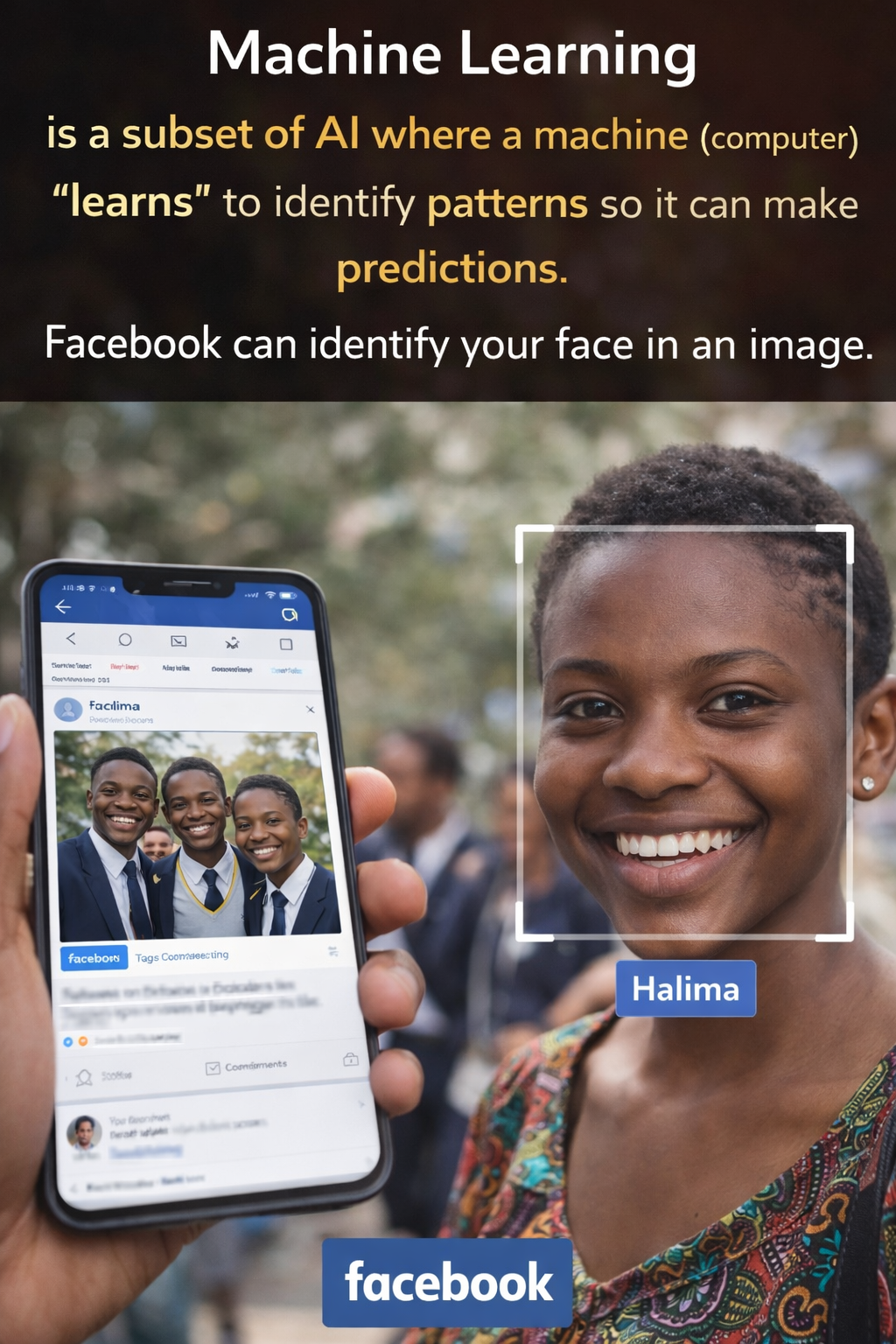
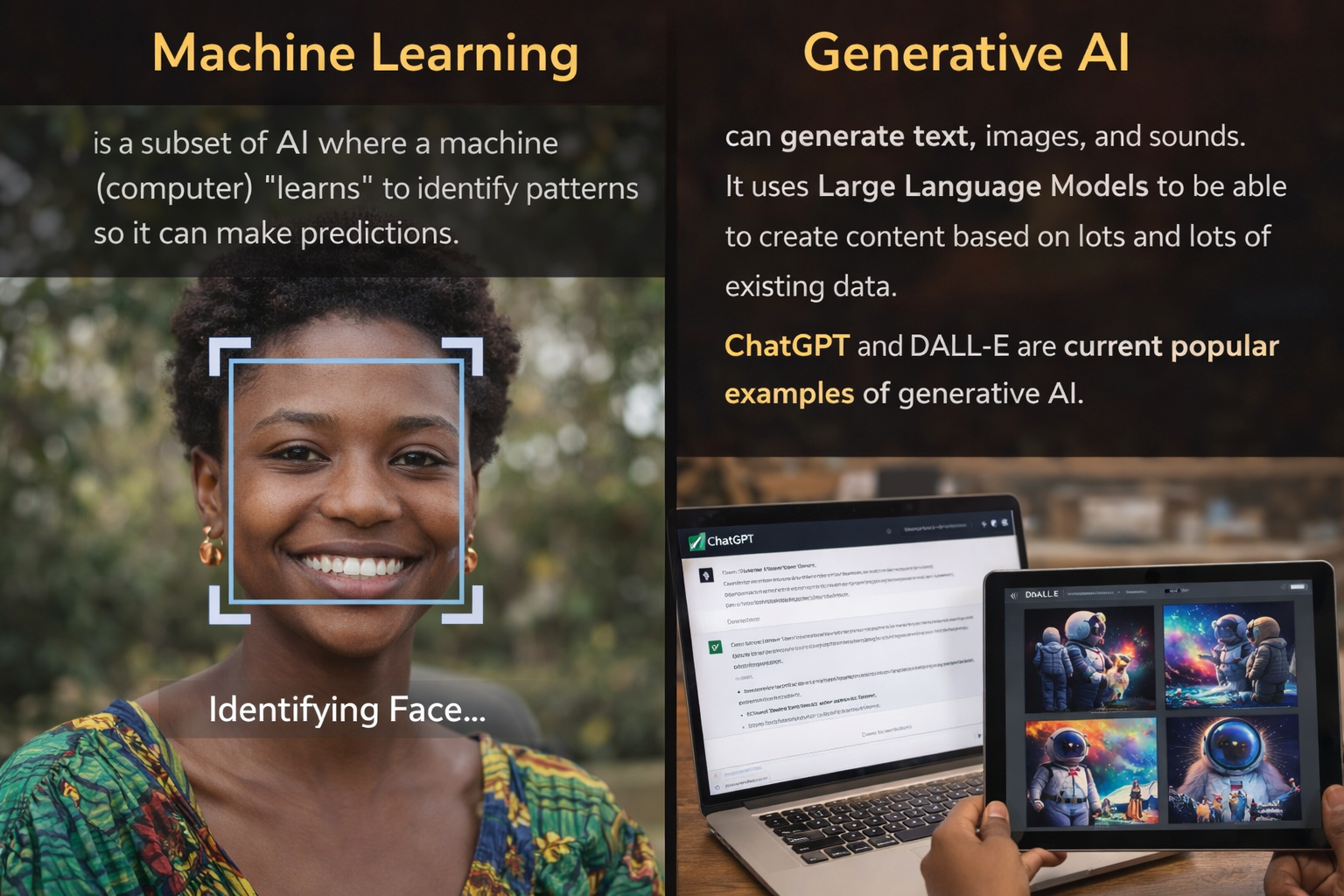
Machine Learning is a part of Artificial Intelligence where computers learn from data.

Instead of programming every instruction manually, the computer studies examples and learns patterns.

After learning patterns, the computer can make predictions.

This is similar to how humans learn from experience.

Example:

If you see many dogs, you learn what a dog looks like.

Later, when you see a new dog, you recognize it easily.

Machine Learning works in the same way.

Real-life examples of Machine Learning
YouTube Recommendations

When you watch videos on YouTube, YouTube studies:

  • what videos you watch

  • how long you watch

  • what you click

Then YouTube predicts videos you may like next.

Face Recognition

Your phone can recognize your face and unlock.

This happens because AI has learned patterns from your face data.

Β 

Google Maps

Google Maps predicts:

  • the best route

  • traffic conditions

  • arrival time

It learns from millions of users.

2. Generative AI
Generative AI is another type of Artificial Intelligence.

Generative AI creates new content.

It can generate:

  • text

  • images

  • music

  • videos

  • voices

Examples include:

  • ChatGPT

  • DALL-E

  • AI image generators

  • AI chat assistants

Generative AI uses something called Large Language Models.

These models are trained using massive amounts of data.

They learn patterns and generate new content.

HOW MACHINE LEARNING WORKS

Machine Learning works using three main parts.

These parts are very important.

PART 1: DATASET

A dataset is a collection of data.

AI learns using data.

Without data, AI cannot learn.

Examples of datasets include:

  • photos

  • voice recordings

  • text

  • videos

  • user behaviour

  • sensor information

Example:

To build an AI that recognizes crops, you need many images of crops.

Where does AI get data?

AI gets data from many sources.

Including:

  • mobile phones

  • websites

  • apps

  • cameras

  • sensors

  • social media

Even everyday activities create data.

Example:

When you:

  • search Google

  • watch YouTube

  • use GPS

  • use mobile money

You are creating data.

PART 2: FINDING PATTERNS

After receiving data, AI studies it.

It looks for patterns.

Patterns help AI understand relationships.

Example:

AI learns:

  • which videos you watch most

  • which routes have traffic

  • which images look similar

This learning process is called training.

PART 3: MAKING PREDICTIONS

After learning patterns, AI can make predictions.

Predictions help AI make decisions.

Example:

Google Maps predicts:

  • best route

YouTube predicts:

  • next video

Phone predicts:

  • your face

AI does not guess randomly.

It uses learned patterns.


REAL LIFE EXAMPLE: GOOGLE MAPS

Let us understand this step-by-step.

Dataset

Google Maps collects:

  • your location

  • your destination

  • traffic information

  • travel speed

Pattern Learning

Google Maps studies:

  • which roads are fast

  • which roads have traffic

Prediction

Google Maps predicts:

  • best route

  • arrival time

ANOTHER EXAMPLE: YOUTUBE

Dataset:

  • videos watched

Pattern learning:

  • types of videos liked

Prediction:

  • recommended videos

AI IS ALREADY IN YOUR DAILY LIFE

Artificial Intelligence is everywhere.

Examples include:


Smartphones

  • face unlock

  • voice assistants

Social Media

  • video recommendations

  • friend suggestions

Online Shopping

  • product recommendations

Banking

  • fraud detection

Education

  • learning apps

  • revision assistants

Agriculture (Uganda Example)

AI can help:

  • detect crop disease

  • predict weather

  • recommend fertilizers

HOW AI CAN HELP YOUR ICT CLUB PROJECT

Your team can use AI in your innovation project.

Example ideas:

Example 1: School Revision App

Dataset: student performance

Pattern: weak subjects

Prediction: recommended revision topics


Example 2: Health App

Dataset:

  • patient symptoms

Pattern:

  • illness patterns

Prediction:

  • possible disease


Example 3: Agriculture App

Dataset:

  • crop images

Pattern:

  • disease patterns

Prediction:

  • crop disease


Example 4: Traffic App

Dataset:

  • accident records

Pattern:

  • dangerous roads

Prediction:

  • accident risk


IMPORTANT KEY TERMS

Artificial Intelligence (AI)

Computer systems that perform tasks requiring intelligence.

Machine Learning

AI that learns patterns from data.

Generative AI

AI that creates new content.

Dataset

Data used to train AI.

Prediction

Decision made by AI using learned patterns.

Large Language Model

AI trained to understand and generate text.

Example:Β ChatGPT

Explore some of the websites below to get a taste of what AI can do.

As you explore, consider:

  • Could you take the concept in front of you and apply it in a different context?
  • What sort of data do you think is needed to make these applications work?

Instrument PlaygroundΒ – based on an image, AI generates what it believes you would hear if you were actually there.
AutoDrawΒ – takes your doodling and predicts what it is you’re trying to draw, very quickly!
X Degrees of separationΒ – takes two art pieces and shows us a bridge of similar artworks that connects the two together.

WHY AI IS IMPORTANT FOR OUR FUTURE

Artificial Intelligence can help Uganda solve many problems.

Including:

Education
Agriculture
Health
Transport
Business
Security

Ugandan students who learn AI will become future innovators.

REFLECTION QUESTIONSΒ 

Discuss as a team:

What AI tools do you use daily?

Example:

Phone
YouTube
Google

How could AI help solve your project problem?

What data would your AI need?

What prediction would your AI make?

SUMMARY

Artificial Intelligence allows computers to act intelligently.

Machine Learning helps AI learn from data.

Generative AI creates new content.

AI works using:

Data
Patterns
Prediction

AI is already part of daily life.

ICT Club students can use AI to build powerful innovation projects.

ADDITIONAL RESOURCES

Want to explore some more cool AI?