
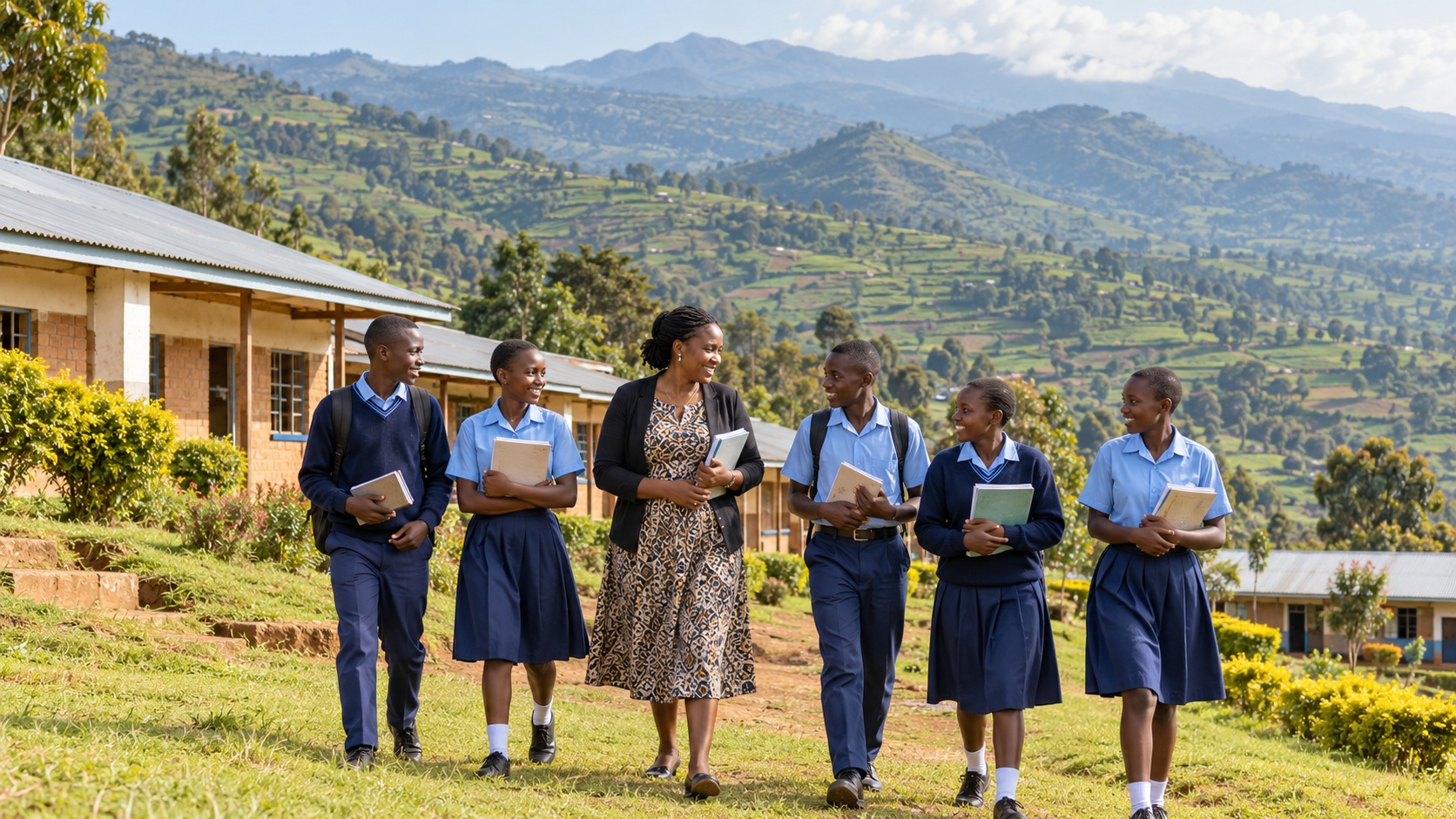
Sebei sub-region · Eastern Uganda
Schools in Bukwo District
A guide to education, school choices and learning
opportunities for families, teachers and school leaders.
Reviewed 27 October 2026
Bukwo: education and opportunity on Mount Elgon
Bukwo is part of Uganda’s Sebei sub-region, where mountain
communities, farming and cross-border connections shape everyday life.
A useful school guide should help families find a school, understand
the available evidence and ask the right questions before enrolling a
child.
This updated page retains the original district profile and every
school listed. New information is dated and sourced below. Where an
earlier claim cannot be verified, it is identified clearly rather than
presented as a current fact.
the 2024 census
retained in this directory
retained in this directory
Population: UBOS,
Sebei Sub-Region Census 2024 Report. Directory figures count
entries in the supplied page, not all operating schools in Bukwo.
Population and administrative update
The 2024 census recorded 55,683 males and 58,713 females,
giving a total of 114,396 people. Use this dated
census count in preference to the original approximate population
projection. It is not a 2026 population estimate.
The district’s official overview describes two counties, 17
rural sub-counties, four town councils, 109 parishes/wards and 791
village councils. This differs substantially from the older
administrative description retained below. The webpage does not
clearly date that administrative snapshot; confirm any gazetted
changes with the district before using the figures for formal
planning.
That overview dates district status to July 2005
and locates the headquarters in Bukwo Town. The district’s location
page lists Amudat to the north, Kenya to the east and south, and Kween
to the west and northwest.
Sources: Bukwo
District overview; district
location and boundaries.
Additional source: Ministry
of Finance — Bukwo investment profile, 2023/24.
What recent education sources report
The Ministry of Education and Sports’ Education Statistics
Abstract 2025 records the following figures for Bukwo in
its district tables:
| Level | Government | Private | Total |
|---|---|---|---|
| Primary | 49 | 15 | 64 |
| Secondary | 11 | 4 | 15 |
The abstract also reports 37,550 primary learners.
These are figures within that publication’s reporting coverage; they
are not a fresh count conducted for this page.
Source: MoES
Education Statistics Abstract 2025, printed pages 67, 72 and 77
(PDF pages 84, 89 and 94).
A separate 11 November 2025 UBC report of the
President’s visit cited 49 government and 44 private primary schools,
and 10 government and nine private secondary schools. Those figures
differ from the Ministry’s abstract. The sources should not be
combined into a single district total without reconciling their dates,
definitions and coverage.
Source: Uganda
Broadcasting Corporation, 11 November 2025.
UBOS published its Baseline Education Census 2025 report on
21 September 2026. Its portal provides a newer census
resource, but a reliable Bukwo-specific total could not be retrieved
for this review. The older claim of approximately 120 primary schools
and 20 nursery schools therefore remains unverified; it is preserved
below as part of the original text.
Sources: UBOS
report announcement; Baseline
Education Census portal.
For parents and learners
Choose a school that fits your child
Confirm the essentials
Ask for the school’s registered name, location, classes offered
and examination arrangements. Check whether it is day, boarding or
both, and whether the relevant classes are currently admitting
learners. A name in this directory is not confirmation of
registration or accreditation.
Understand the full cost
Request a written breakdown of fees, meals, uniforms, transport,
boarding and other charges. Ask about payment arrangements and
obtain official receipts. Confirm the school’s payment channel
directly before sending money.
Look at teaching and care
Ask about teacher attendance, reading and mathematics support,
textbooks, practical lessons and recent official results. Inspect
water, toilets, menstrual-health facilities and boarding
conditions. Discuss disability access and support for a learner
who needs additional help.
Check the journey
Assess the route during wet weather, including steep paths and
river crossings. Ask how the school communicates dangerous
conditions, closures and collection arrangements. Choose transport
that is safe and reliable throughout the term.
Use examination results responsibly
No verified current school-by-school ranking has been added. Request
the examination year, number of candidates and official grading
explanation from each school. Consider learning progress, safety and
teaching alongside examination results.
Ask about vocational pathways
The original profile mentions Bukwo Vocational Training Centre.
Before applying, confirm its current operating name, registration,
approved programmes, awarding body, practical training facilities and
fees. A historical mention does not establish present accreditation.
KAWA · Practical learning
Build digital skills around local needs
Schools can use technology to strengthen everyday teaching and help
learners solve familiar problems. The actions below are proposals for
school improvement, not announcements of completed KAWA or UCC
projects in Bukwo.
Start with equipment and teacher readiness
List working computers, available power, classroom space and learning
resources. Agree on teacher training, a timetable for learner access
and a maintenance budget. Where internet access is unreliable, discuss
offline resources and local-network options for KAWA CONNECT. Confirm
the content, support and access arrangements before implementation.
Give ICT clubs purposeful projects
- Agriculture: record school-garden inputs,
rainfall observations and harvests in spreadsheets. - Local enterprise: practise costing, stock records
and simple business calculations using fictional or consented data. - Communication: produce a school newsletter,
reading recordings or supervised local-history interviews. - Environment: document safe, teacher-approved
observations and develop classroom awareness materials. - Sport: use training logs and charts to connect
physical education with mathematics and data skills.
Provide equal opportunities for girls, boys and learners with
disabilities. Teach learners to protect passwords, check information
and obtain permission before publishing another person’s photograph or
story.
Keep learners connected to school
Review absence regularly and work with families to identify practical
barriers. Prepare printed activities and offline materials for
disruptions. Maintain emergency contacts, safe assembly arrangements
and procedures agreed with district authorities.
Retained district profile and school directory
The original information and every listed school appear below.
Visible text-encoding errors have been repaired. Read numerical and
time-sensitive statements alongside the updates above.
Bukwo District — Uganda’s High-Altitude Frontier in the
Sebei Sub-Region
Bukwo District occupies the eastern slopes of Mount Elgon,
forming Uganda’s rugged frontier with Kenya. Officially established
on 1 July 2005 after being carved out of Kapchorwa
District’s Kongasis County, Bukwo Town now serves as the district’s
political and commercial centre and a gateway to
the Suam border post.
Geography & Borders
- Borders: Amudat to the north,
Kenya to the east and south, and Kween
to the west and northwest. - Terrain: Steep volcanic escarpments,
deep valleys and high-altitude grasslands, with much of
the land above 1 700 m. - Climate & Soils: Cool temperatures, high
rainfall and fertile volcanic soils favour
potatoes, wheat and vegetables, but the same steep terrain hampers
road access and exposes communities to landslides.
Administrative Structure
Bukwo District consists of one parliamentary county,
Kongasis, subdivided into:
- Seven rural sub-counties — Bukwo,
Chesower, Kapkoros, Kabei, Riwo, Suam, Kortek - Bukwo Town Council and the emerging Suam
Border Town Council
Below these are about 40 parishes and over
250 villages, giving local councils the reach to mobilise
scattered high-slope communities.
Population & Migration
- Population (2014): ~ 89 000 | Projected
(2025): ~ 115 000 - Density: ~ 140 people per km² on roughly 525
km² of land. - Ethnicity: Predominantly Sabiny
(Sebei) clans, with small Pokot settlements along the
northern ridge. - Key issue — Brain-drain: Many well-educated
Sabiny youth relocate to Kenya for teaching, athletics
and security jobs, draining local professional capacity but
sending remittances home.
Economy & Livelihoods
- Staple crops: Irish potatoes, maize,
beans, sorghum, wheat and barley
grown on narrow terraces. - Cash activities: Cross-border produce
trade, informal livestock sales and smallholder honey
and coffee ventures. - Livestock: Goats, sheep, zebu cattle and
emerging dairy herds graze on montane pastures. - Key issue — Insecurity: Occasional cattle
rustling and cross-border raids disrupt farming and
trade, highlighting the need for sustained peace-building.
Education & Human Capital
Bukwo hosts approximately 120 primary schools, 20 nursery
schools and 15 secondary schools, plus Bukwo
Vocational Training Centre. Enrollment is improving, yet:
- Long, rugged walks discourage daily attendance,
especially for girls. - ICT access is minimal; most schools lack
computers, power or internet. - Opportunity: District leaders are courting
partners to pilot solar-powered computer labs
and mountain-adapted e-learning content to curb
youth out-migration.
Infrastructure & Social
Services
- Roads: Many feeder routes become impassable
in heavy rains, isolating farms and markets. - Electricity: Grid coverage is below 10
%; most households rely on small solar kits or
kerosene. - Water: Springs and gravity-flow
schemes supply many upland villages, but dry-season
shortages persist. - Health: Bukwo General Hospital (100
beds) is the only referral facility; frequent drug
stock-outs and staff shortages remain
critical concerns.
Governance & Development
Outlook
District governance —led by the LC5 Chairperson, Resident
District Commissioner (RDC) and Chief Administrative Officer (CAO)”prioritises:
- Road rehabilitation to connect terraces to the
Suam highway. - Electrification and solar mini-grids for
schools and trading centres. - ICT integration in classrooms to retain skilled
youth. - Cross-border peace-building to curb rustling
and foster trade.
Bukwo District blends spectacular
mountain landscapes, fertile volcanic soils and an industrious
Sabiny populace with pressing challenges of rugged
terrain, limited infrastructure, periodic insecurity and youth
brain-drain. Targeted investment in roads,
power, water and digital education will be decisive in
turning Bukwo’s natural advantages into sustainable prosperity for
its high-altitude communities.
Secondary Schools in Bukwo District
- Amanang Secondary School
- Border College Academy
- Chepkwasta Secondary School
- Chesower Secondary School.
- Eastern College Chebinyiny
- Kabei Secondary School
- Kamet Secondary School
- Kapkoros Peace High School
- Kapkoros S S
- Kapyoyon High School
- Kortek Girls Secondary School
- Riwo Secondary School, Bukwo
- John Bosco Girls Secondary School
- Joseph S Secondary School
- Tulel Secondary School
Primary Schools in Bukwo District
- Amanang Primary School
- Aralam Primary School
- Aryowet Primary School
- Bishop Augustus Primary School
- Blossom Standard Academy
- Brim Primary School
- Brirwok Primary School
- Bukwo Christian Primary School
- Bukwo Elite Primary School
- Bukwo Primary School
- Chebinyiny Primary School
- Cheboi Primary School
- Chekwir Green Valley Primary School
- Chekwir Primary School
- Chemukang Primary School
- Chemuron Parents Primary School
- Chemuron Primary School
- Chemwabit Primary School
- Chepkukui Primary School
- Chepkuto Primary School
- Chepkwasta Baptist Primary School
- Chepkwasta Junior Primary School
- Chepkwasta Primary School
- Chesimat Primary School
- Chesower Daystar Primary School
- Chesower Primary School
- Christ Faith Primary School
- Dayspring Primary School
- Ebenezer Sosio Academy
- Elgon Progressive Primary School
- Elgon View Primary School
- Faith Homes Primary School
- Forest View Academy Primary School
- Future Harvest Academy
- Grace Gardens Primary School
- Grace Junior Academy
- Green Field Academy
- Juliets Primary School
- Kabei Primary School
- Kabokwo Primary School
- Kamet Christian Academy
- Kamet Primary School
- Kamet Sunshine Primary School
- Kamokoyon Primary School
- Kamuchan Primary School
- Kapchemoken Primary School
- Kapchesoy Primary School
- Kapkoros Christian Primary School
- Kapkoros Primary School
- Kapnadi Faith Primary School
- Kapngokin Primary School
- Kapsarur Primary School
- Kapsekek Primary School
- Kapsiywo Primary School
- Kaptererwa Primary School
- Kaptomologon Primary School
- Kapyoyon Primary School
- Koikoi Primary School
- Kokopchaya Primary School
- Kongasis Standard Academy
- Kortek Junior Academy
- Kortek Primary School
- Kwirwot Primary School
- Lwongon Primary School
- Mokoyon Primary School
- Muimet Primary School
- Muton Primary School
- Mutushet Primary School
- Nakewa Campus Primary School
- Ndilai Primary School
- New Vision
- Nyalit Parents Primary School
- Riwo Hill Primary School
- Riwo Primary School
- Royal Academy
- Rwandet Primary School
- Senendet Primary School
- Sossyo Primary School
- Francis Primary School
- Johns Primary School
- Jude Primary School
- Lawrence Academy
- Paul Kapseneton Primary School
- Peter Primary School-kapkware
- Suam Primary School
- Tartar Primary School
- Tul Rok Val Christian Primary School
- Tulel Primary School
- Tuyobei Primary School
- Yemitek Primary School
Verify or improve a school entry
Schools can help KAWA improve this guide by providing their official
name, parish and sub-county, public contact, registration details,
classes offered, day or boarding status, accessibility arrangements
and the date the information was checked. Include dated evidence for
results and new facilities; do not submit learners’ private records
for public display.
For district-level verification, start with the Bukwo
District Education Department. The official website lists P.
O. Box 02, Bukwo and +256 772
611244 as district contact details. Ask to be directed to the
Education Office; the number is not identified as a dedicated
admissions line.
Is this a complete list of currently operating schools?
No. It preserves the supplied directory: 15 secondary and 90
primary entries. Confirm additions, closures, changed names and
current registration with the district.
Why do the reported school totals differ?
The Ministry abstract, a public speech reported by UBC and this
directory are different records. Their reporting coverage and
reference dates may differ. A reconciled register from the Education
Office is needed before treating them as one count.
Does a listed school already have KAWA CONNECT?
This page does not establish installation or subscription status at
any listed school. Confirm directly with the school and KAWA.



Leave a Reply
You must be logged in to post a comment.