
Understanding TV Digital Content: Structure, Development and Tools — Insights from Dr. Moses Tuhame, Manager of ICT and Multimedia Services at the National Curriculum Development Centre
Beyond the Television Screen: How NCDC Envisions the Future of Digital Educational Content in Uganda
Understanding TV Digital Content: Structure, Development and Tools — Insights from Dr. Moses Tuhame, Manager of ICT and Multimedia Services at the National Curriculum Development Centre.
By Moses Wamanga | KAWA Uganda
23 October 2026
Uganda’s education sector is entering an important period in which television, digital learning platforms, local educational content and emerging technologies could work together to expand access to quality learning. The challenge is no longer simply whether schools have computers, television sets or internet connectivity. It is whether these technologies can deliver meaningful, curriculum-aligned learning experiences that reach children wherever they live.
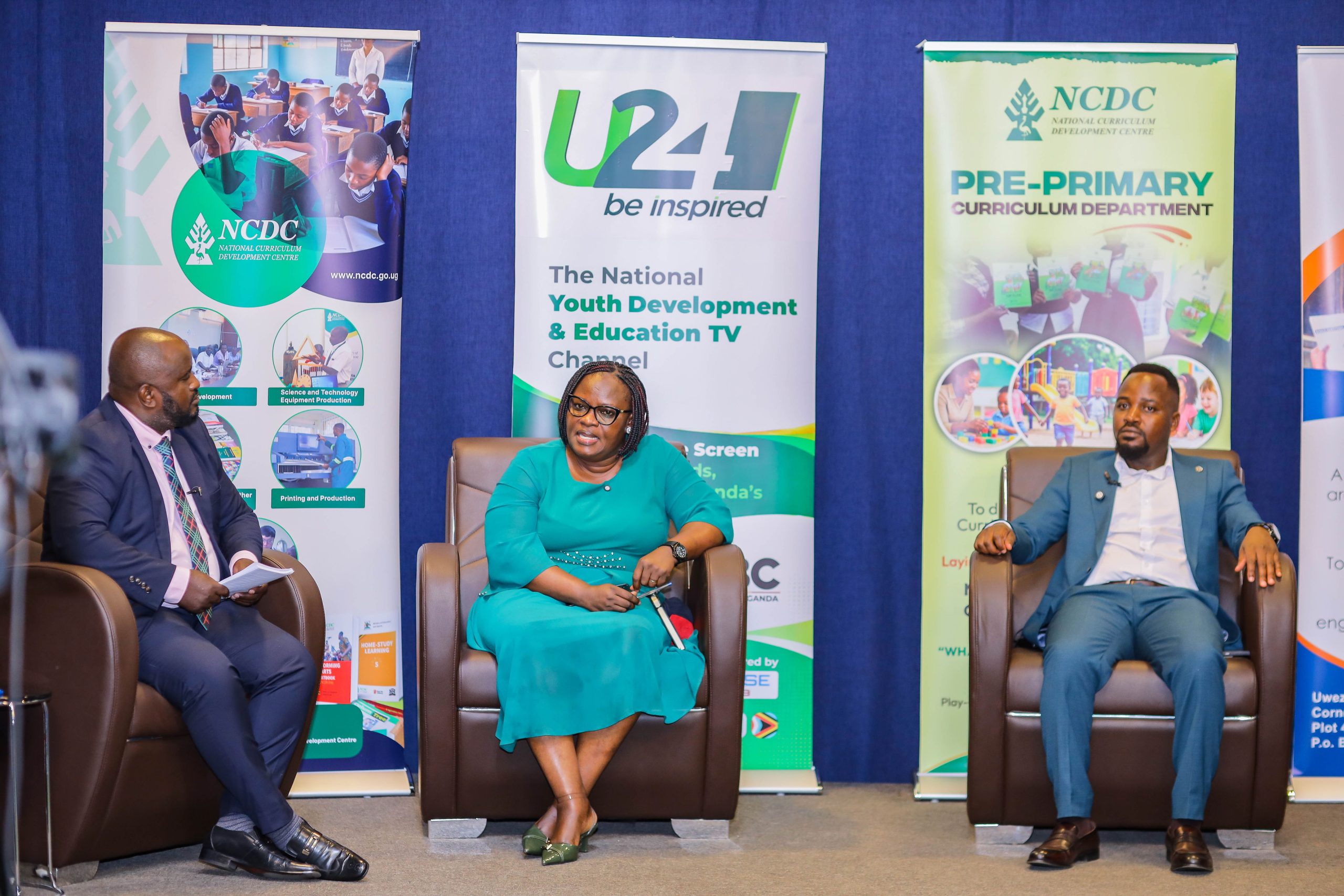
This was one of the central issues explored by Dr. Moses Tuhame, Manager of ICT and Multimedia Services at the National Curriculum Development Centre (NCDC), during his presentation titled “TV Digital Content: Structure, Development & Tools.”
The presentation formed part of discussions surrounding the NCDC-U24 TV educational broadcasting initiative. It examined how Uganda can develop educational content, ensure its quality, distribute it through different technologies and use feedback from learners and teachers to improve educational outcomes.
For teachers, parents, school leaders, curriculum developers, universities, educational technology organisations and the wider public, the presentation raised an important question: How can Uganda move from simply broadcasting educational programmes to building a connected system that supports learning, creativity, innovation and national development?
The Educational Paradox: Millions Begin School, but Far Fewer Reach Higher Education
Dr. Tuhame opened part of his presentation with a slide titled “It Starts from a Paradox.”
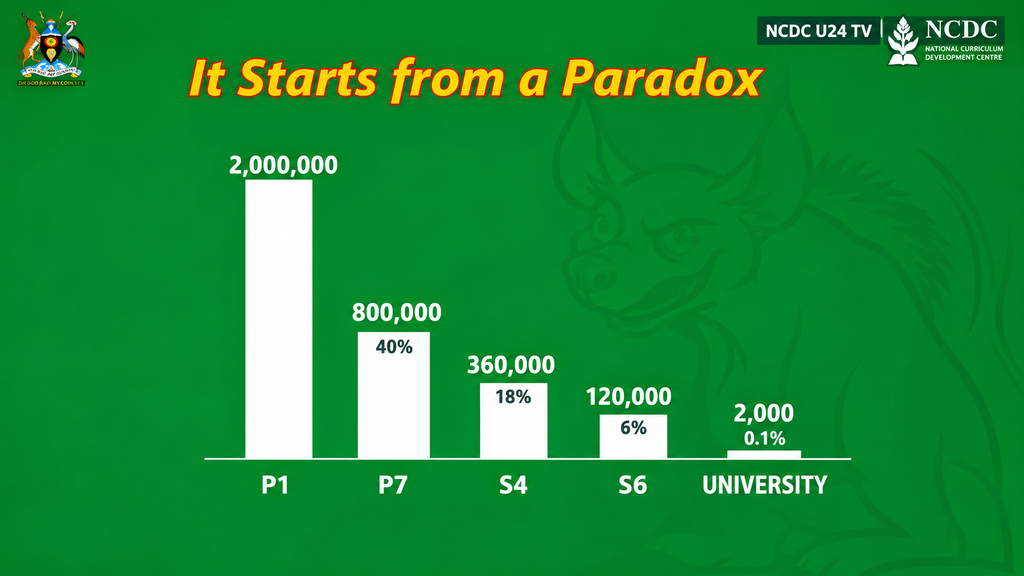
The illustration showed a dramatic reduction in learner numbers across successive stages of education.
The figures presented included approximately two million learners at Primary One, 800,000 at Primary Seven, 360,000 at Senior Four, 120,000 at Senior Six and 2,000 at university. The slide also raised concerns about unemployment and low-quality education.
These figures were used as an illustration of the challenges facing education. They should not be interpreted as a verified longitudinal study of one group of learners or as current national transition statistics without further examination of the underlying data.
Nevertheless, the message was clear: enrolling children in school is only the beginning. A successful education system must also help learners progress, acquire useful competencies and prepare for productive participation in society.
This raises several questions. What happens to learners who do not proceed to the next level of education? Are those who complete school equipped with practical skills? Can technology help learners who have limited access to textbooks, laboratories and specialist teachers? And can educational broadcasting support learning beyond the traditional classroom?
Digital educational content cannot independently resolve these challenges. However, when properly designed and supported by teachers, parents and institutions, it can become an additional means of expanding learning opportunities.
Why Uganda Needs More Than Educational Television
One of the most significant messages from the presentation was that Uganda already possesses important educational resources, but these resources do not always reach the people who need them.
NCDC develops curriculum frameworks and educational materials. Teachers prepare lessons and practical activities. Schools invest in computers and other technologies. Universities conduct research, while learners develop projects and innovations. Yet these resources often remain disconnected.
A school may have a functioning computer laboratory but lack appropriate digital lessons. A teacher may develop an excellent classroom activity that never reaches colleagues in other schools. A learner may produce an impressive innovation that remains within the school compound. Similarly, educational institutions may possess valuable content that is not readily accessible to families.
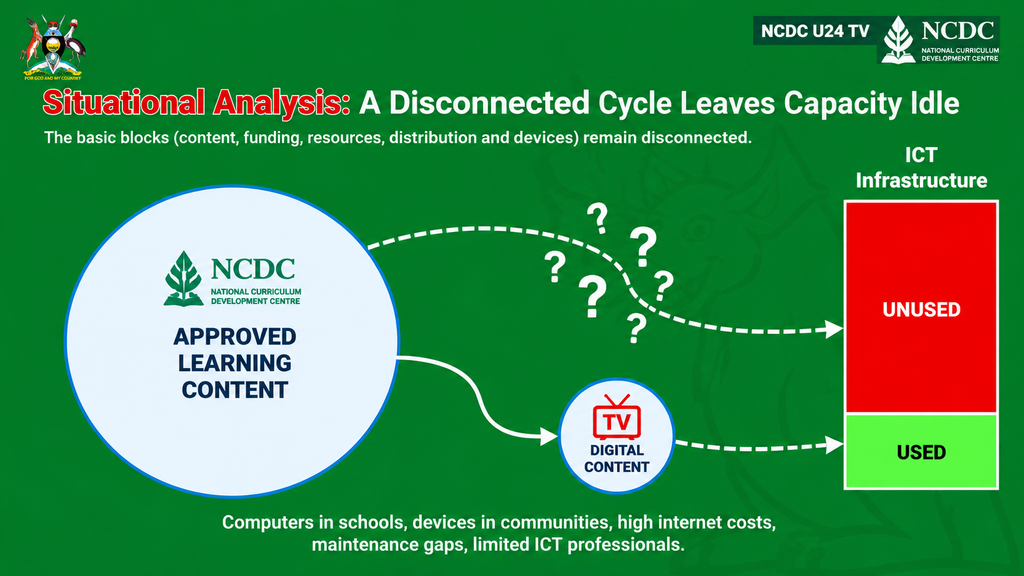
Dr. Tuhame described this situation through a slide titled “Situational Analysis: A Disconnected Cycle Leaves Capacity Idle.”
The presentation illustrated the gap between approved learning content, digital content production and the effective use of ICT infrastructure.
The broader lesson is that investment in technology must be accompanied by investment in relevant content, teacher preparation, distribution and maintenance.
Providing computers without appropriate educational resources limits their usefulness. Producing digital content without ensuring that learners can access it creates another challenge.
A connected educational system must address both problems.
From Textbooks to Television: How Digital Educational Content Is Developed
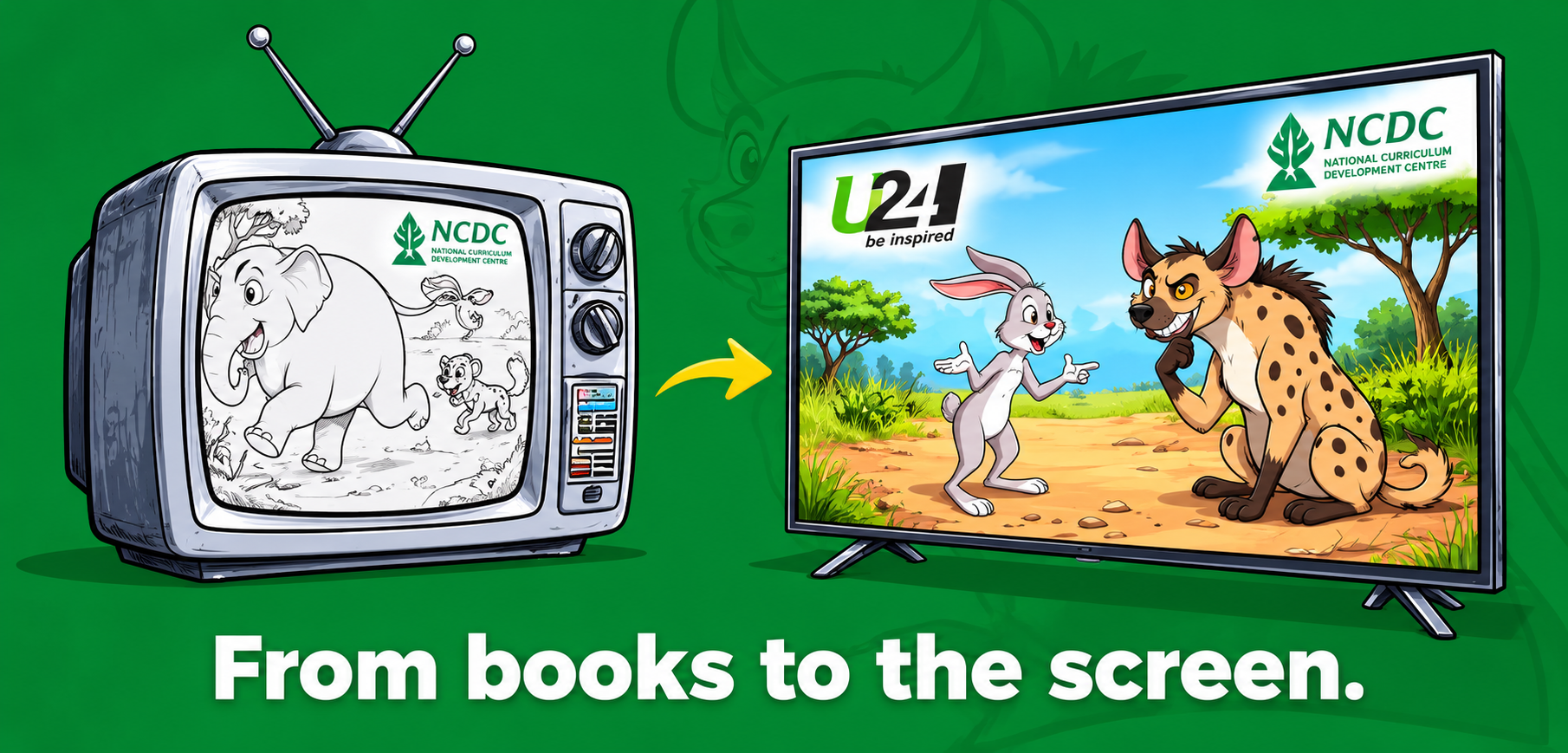
One of the practical sections of the presentation demonstrated how material originally developed for a textbook can be transformed into a television learning experience.
Using an illustrated story from The Nile English Course, Dr. Tuhame demonstrated a sequence involving a textbook illustration, a developed visual scene and a video presentation.
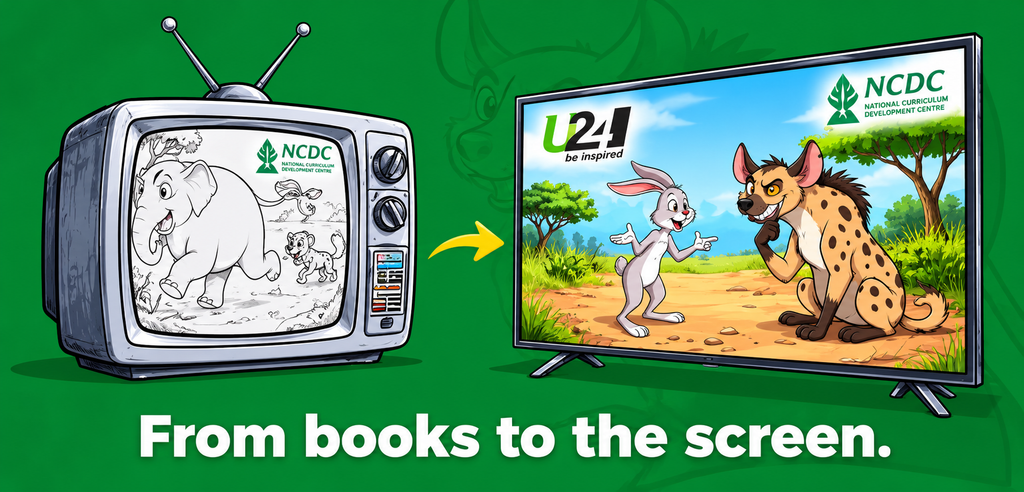
This process is important because converting a textbook into television content requires much more than displaying pages on a screen.
A textbook is designed primarily for reading. Television communicates through moving images, narration, sound, demonstrations and visual storytelling.
A successful educational video must therefore reinterpret the learning material for a different medium.
For example, a Primary Four English textbook may contain a story about animals. In the printed book, learners read the story and study accompanying illustrations.
For television, the same story could be developed into an animated sequence with characters, dialogue, narration and questions that encourage comprehension.
The process should begin by identifying the intended learning outcomes. Content developers then prepare a script, storyboard the visual sequence, create or obtain illustrations, record narration, produce the video and review the final material.
Curriculum specialists and subject experts must ensure that the finished programme remains accurate and educationally appropriate. This is especially important when artificial intelligence tools are used to generate illustrations, voices, translations or animations. AI can support production, but its outputs still require human verification.
A visually attractive programme is not necessarily an effective lesson. Its educational value depends on what learners understand and can demonstrate after engaging with it.
Artificial Intelligence, African Languages and Inclusive Learning
Another notable section of the presentation explored stories and language translation, including reference to Sunbird AI and African-language technologies. Uganda’s linguistic diversity presents both an opportunity and a challenge for digital education.
Educational programmes delivered exclusively in English may be less accessible to some younger learners, parents and communities. Local-language support can improve comprehension, particularly where learners are developing foundational literacy skills.
Artificial intelligence offers possibilities for translating educational explanations, producing subtitles, generating speech and adapting content for different audiences.
For example, a science programme explaining photosynthesis could be produced in English and accompanied by carefully reviewed explanations in selected Ugandan languages.
However, translation requires more than replacing individual words. Scientific terminology, cultural meaning, pronunciation and age-appropriate language must all be considered.
AI-generated translations can contain errors, particularly for languages with limited digital training resources. Teachers, language specialists and curriculum experts therefore remain essential.
The opportunity is to use technology to make educational content more accessible without compromising accuracy.
What Kind of Content Should Educational Television Broadcast?
Dr. Tuhame challenged participants to think beyond conventional classroom lessons. His presentation suggested that educational television can become a platform for imagination, innovation and national development.

One slide compared Uganda’s Moroto Hills with the cable-car infrastructure in Cape Town, South Africa.
The comparison encouraged participants to think about how geographical features can inspire engineering, tourism, infrastructure development and innovation. Such examples can help learners connect classroom subjects with real-world possibilities.
A Geography lesson about mountains can lead to discussions about tourism and environmental conservation. A Physics lesson can explore how cable transport systems operate. An Entrepreneurship lesson can investigate business opportunities associated with tourism.
This approach reflects an important principle of competency-based education: learners should be encouraged to apply knowledge rather than merely reproduce information.
The presentation also identified opportunities for locally produced content covering agriculture, tourism, transport, public services, culture and other areas of national life.
Uganda has numerous learning environments that could be documented for educational television. Farms, factories, national parks, cultural sites, research institutions, health facilities and engineering projects can all provide material for curriculum-linked programmes.
A documentary about a Ugandan farmer using irrigation technology could support lessons in Agriculture, Geography, Science and Entrepreneurship.
A programme about road construction could introduce learners to engineering, measurement, environmental management and public infrastructure.
Educational television should therefore help learners understand their country while developing curiosity about the world.
Bringing Learner Innovations Out of School Laboratories
A particularly thought-provoking section of the presentation concerned learner projects under Uganda’s Competency-Based Curriculum.
Dr. Tuhame questioned why so many innovations and research projects remain on shelves rather than being documented, shared and developed further.
The presentation referred to the substantial number of projects associated with Senior Four learners and raised the possibility of establishing a repository for learner innovations and university research.
This is a significant opportunity.
Across Uganda, learners are developing projects related to agriculture, environmental protection, health, communication, waste management and digital technology.
However, many projects are presented during school exhibitions or assessment activities and receive little attention afterwards.
Educational television could provide a platform for documenting these innovations, explaining the problems they address and introducing the learners behind them. Such programmes could also connect promising projects with universities, researchers, entrepreneurs and potential development partners.
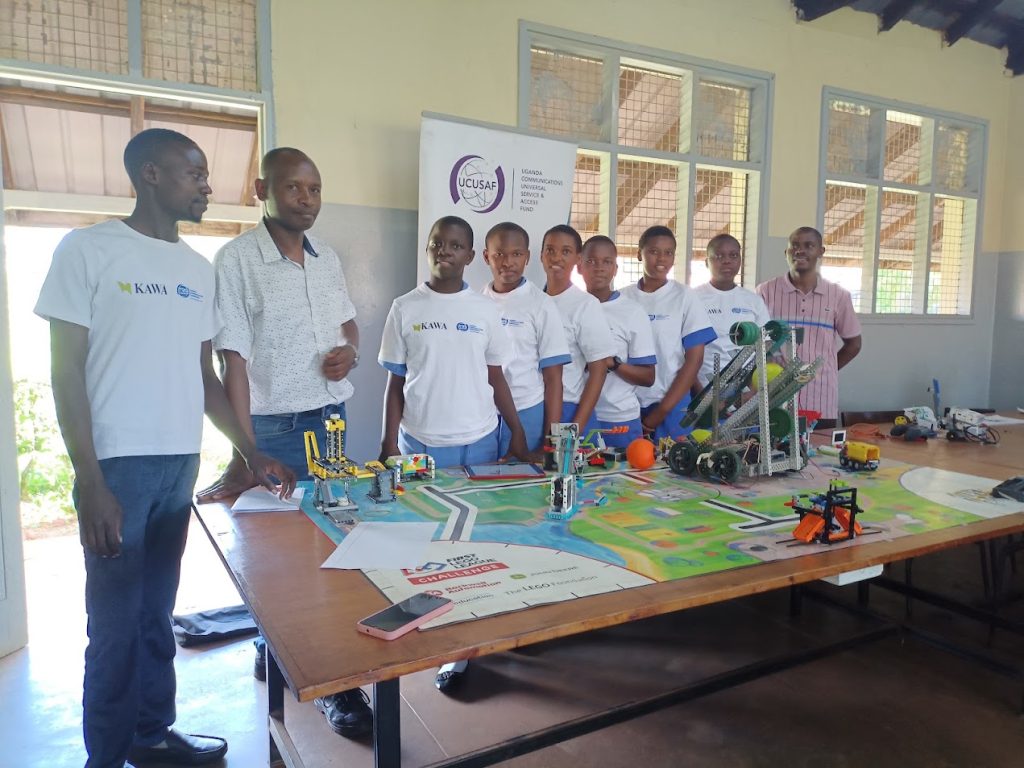
For example, a school ICT Club that develops a digital tool for improving waste collection could be featured in a short documentary. Viewers could learn about the problem, the design process, the technologies used and the challenges encountered.
This would make the programme educational even for learners who are not directly involved in the project.
It could also encourage schools to view learner projects as opportunities for continued learning and improvement rather than activities that end after assessment.
Recognising Excellent Teachers Through Model Lessons
Another important question raised during the presentation was:
“Model Teachers who get awards, where are the model lessons?”
The question highlights an opportunity to connect teacher recognition with professional learning.
Teachers are frequently recognised for outstanding performance, innovation and commitment. However, their successful teaching practices are not always documented in formats that other teachers can study and adapt.
Educational television could help address this gap.
An outstanding Mathematics teacher could demonstrate how to teach fractions using locally available materials. A Science teacher could show how to conduct practical investigations using affordable equipment. An English teacher could demonstrate techniques for improving reading comprehension.
These lessons could be broadcast, archived and used during teacher professional development programmes.
The purpose would not be to prescribe one teaching method for every classroom, but to provide examples of effective practice that teachers can evaluate and adapt.
This would be especially valuable for teachers working in schools with limited access to continuous professional development.
The NCDC-U24 TV Ecosystem: Connecting Different Learning Platforms
The presentation introduced an ecosystem with U24 TV at its centre, connected to YouTube, radio, social media and a Learning Management System.
The NCDC Curriculum Framework was presented as the educational foundation guiding the content.
This model recognises that learners do not all access educational resources in the same way.
Some households have television sets but limited internet access. Others use smartphones to watch educational videos. Schools may use computers and local networks, while radio remains accessible to many communities.
A coordinated approach could allow educational resources to be adapted for several channels.
For example, a televised lesson on environmental conservation could also be made available as an online video, supported by radio discussions and accompanied by learning activities on a digital platform.
The same educational topic could therefore reach different audiences without requiring every learner to use the same technology.
An important consideration for Uganda is offline access.
Schools and homes with unreliable internet connectivity may benefit from approved content distributed through flash drives, local servers and other offline technologies, subject to appropriate licensing arrangements.
Digital inclusion must remain a central consideration if educational broadcasting is to reach learners beyond well-connected urban communities.
The Six Stages of an Effective Educational Content Pipeline
One of the most useful frameworks presented by Dr. Tuhame was titled “One Learning Pipeline, from Curriculum to Learner Feedback.”
The model identified six interconnected stages.
1. Curriculum: Educational programmes begin with approved curriculum frameworks, competencies and learning outcomes.
2. Content creation: Subject experts, local producers, creators and other contributors develop educational resources.
3. Quality assurance: Materials are reviewed for curriculum alignment, educational accuracy, inclusivity and relevant cross-cutting issues.
4. Programming and broadcasting: Approved content is organised and delivered through the NCDC-U24 TV broadcasting arrangement.
5. Reach and access: Programmes are made accessible to teachers, learners, schools and other intended audiences.
6. Use and improvement: Feedback and evidence from schools, families and learners inform improvements to the content and its delivery.
The sixth stage is particularly important.
Broadcasting a lesson does not automatically mean that learning has occurred. Educational institutions need ways to understand whether programmes are accessible, understandable and useful.
Teachers may provide feedback about the clarity of explanations. Learners may identify concepts they found difficult. Parents may report challenges related to scheduling or access.
Where digital learning platforms are involved, appropriate assessment and usage information may also help content developers evaluate effectiveness. This creates a continuous improvement process in which educational resources are reviewed and refined over time.
What Can Schools, Universities and Other Institutions Contribute?
Towards the end of the presentation, Dr. Tuhame posed a direct question to participating institutions:
“What can your institution put into the learning pipeline?”
The question reflects the collaborative nature of the proposed ecosystem.
Schools can contribute examples of effective teaching, learner innovations and classroom experiences.
Universities can contribute research, technical expertise, educational technologies and subject specialists.
Content producers can support scriptwriting, filming, animation, editing and post-production.
Technology organisations can provide digital platforms, connectivity solutions, multimedia production facilities and distribution expertise.
Development partners and other institutions may contribute funding, equipment, research support or capacity development.
Such collaboration would require clear arrangements for curriculum approval, editorial responsibility, intellectual property, child protection, accessibility and the use of educational materials.
The opportunity is substantial, but sustainable implementation will depend on well-defined responsibilities and consistent quality standards.
What This Means for KAWA Uganda and KAWA CONNECT
For KAWA Uganda, the presentation connects closely with ongoing work in digital learning, teacher capacity development and learner innovation.
Through KAWA CONNECT, KAWA is developing curriculum-based digital resources intended to support learning at school and at home.
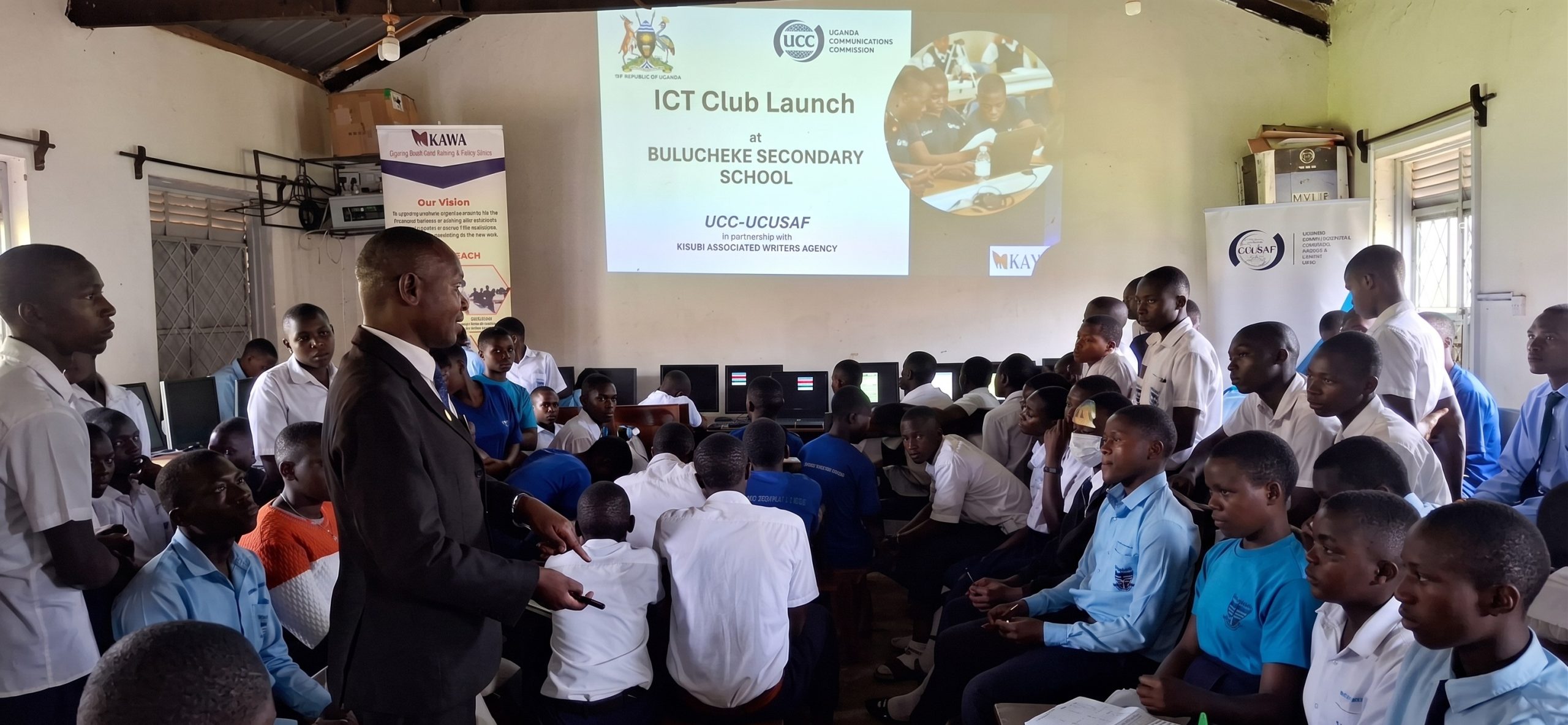
The organisation’s involvement in ICT Clubs also provides opportunities to document practical innovations being developed by learners in Ugandan schools.
These experiences suggest several areas in which KAWA could explore collaboration with NCDC and U24 TV.
KAWA could contribute curriculum-aligned video lessons, documentaries about learner innovations, examples of effective teaching and technical approaches for distributing educational resources through online and offline platforms.
KAWA CONNECT could also complement broadcast learning by providing structured lessons, learning activities and assessments, subject to any necessary technical integration and content-sharing agreements.
Such participation would need to follow NCDC’s requirements for educational quality assurance and partnership approval.
The wider opportunity is to build connections between curriculum development, educational broadcasting, classroom practice and learner innovation.
What Parents, Teachers and School Leaders Should Know
The emergence of educational broadcasting should not be understood as a replacement for teachers or schools.
Television can explain concepts, demonstrate processes and introduce learners to experiences that may be difficult to reproduce in every classroom. However, teachers remain essential for guiding discussion, correcting misunderstandings, organising practical activities and assessing learning.
Parents can support children by encouraging them to watch appropriate educational programmes, asking questions about what they have learned and helping them connect lessons with everyday experiences.
School leaders should consider how television and other digital resources can complement classroom teaching.
A school with a television set or projector could organise supervised viewing sessions followed by teacher-led discussions and practical assignments.
Teachers could also use selected educational videos when preparing lessons, particularly for topics requiring demonstrations or visual explanations.
The value of educational technology should ultimately be measured by the learning opportunities it creates, not merely by the number of devices installed.
Challenges That Must Be Addressed
The vision presented by NCDC is promising, but several practical issues will require sustained attention.
Educational content production can be expensive, especially when it involves professional filming, animation, translation and specialist review.
Reliable distribution also requires appropriate broadcasting infrastructure, electricity, internet connectivity and access devices.
Quality assurance must remain rigorous to ensure that programmes reflect the curriculum and present accurate information.
There are also important questions about accessibility for learners with disabilities, local-language support, safeguarding children featured in programmes and protecting intellectual property.
Finally, content producers and education authorities will need realistic ways to evaluate educational impact.
These challenges should not discourage innovation. Instead, they should inform the design of a sustainable and inclusive educational broadcasting system.
A New Opportunity for Uganda’s Education Sector
Dr. Moses Tuhame’s presentation demonstrated that the future of educational television is not simply about putting teachers in front of cameras or converting textbooks into videos.
It is about creating a coordinated process through which curriculum specialists, teachers, learners, researchers, technology developers, broadcasters and communities contribute to educational resources that are accessible, relevant and continuously improved.
The NCDC-U24 TV initiative provides an opportunity to explore how broadcasting can support Uganda’s competency-based education agenda while giving greater visibility to local knowledge, teacher expertise and learner innovation.
For KAWA Uganda, the discussion reinforces the importance of developing digital educational resources that are grounded in the national curriculum, responsive to the needs of teachers and learners, and accessible across different technological environments.
Uganda’s schools are not merely places where educational content should be consumed. They are also places where valuable knowledge, creative teaching practices and practical innovations are produced every day.
The challenge is to connect these contributions to a wider national learning system.
The future of educational television should therefore be measured not only by what appears on the screen, but by what learners understand, create and are able to do as a result.
About the presentation: TV Digital Content: Structure, Development & Tools was presented by Dr. Moses Tuhame, Manager of ICT and Multimedia Services at Uganda’s National Curriculum Development Centre, during discussions on the NCDC-U24 TV educational broadcasting initiative.
About KAWA Uganda: KAWA works to advance digital education, teacher professional development and learner innovation in Uganda through initiatives including KAWA CONNECT and support for school ICT Clubs.

Leave a Reply
You must be logged in to post a comment.