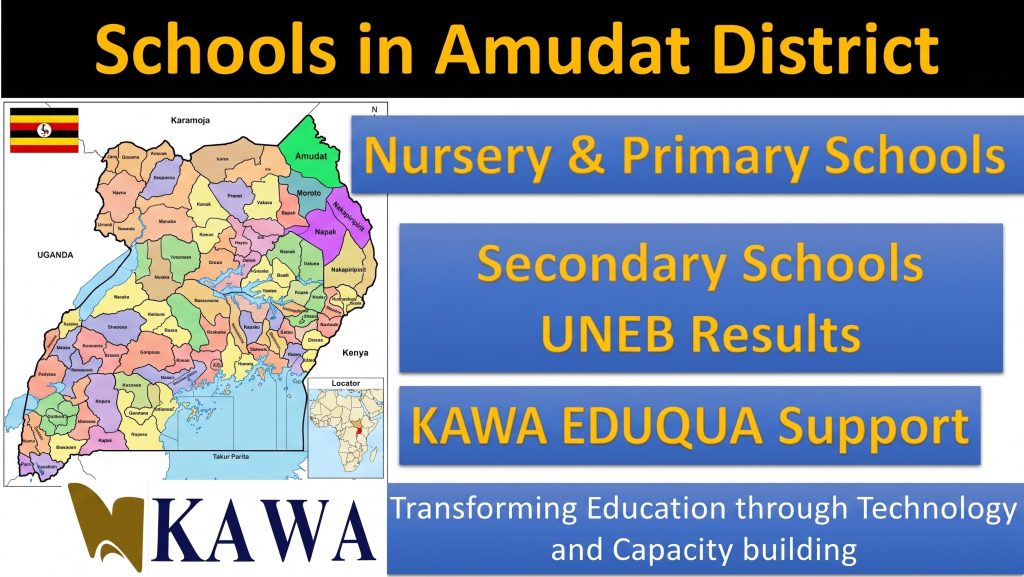
Education in Amudat District: District Education Profile, Institutional Directory & Digital Learning
Amudat District is situated in the Karamoja Sub-region of North-Eastern Uganda along the international border with the Republic of Kenya. Covering an area of approximately 1,616 square kilometres, its administrative headquarters are located in Amudat Town Council, positioned roughly 38 kilometres northeast of Nakapiripirit and about 400 kilometres northeast of Kampala. The district is predominantly inhabited by the Pokot community and features an economy centered on pastoralism, livestock trade, and smallholder farming.
According to the 2024 National Population and Housing Census, Amudat District has a population of 203,358 people (100,537 males and 102,821 females) across 42,310 households. More than half of the population (108,403 individuals) are children aged 0–17 years, including 40,104 aged 6–12 and 24,037 aged 13–18. Educational marginalization remains significant: census data indicates that 34,240 children aged 6–12 and 16,699 adolescents aged 13–17 are currently out of school, while 23,718 children aged 3–5 do not attend Early Childhood Care and Education (ECCE).
KAWA Uganda through the UCC and UCUSAF fund supports district leadership—including the Chief Administrative Officer (CAO), Mr. Seraphine Alia, and the District LC V Chairperson, Mr. William Loram Bwatum—to address geographic barriers, teacher retention issues, and digital infrastructure constraints. Through KAWA Connect offline learning micro-servers, teacher Continuous Professional Development (CPD), and secondary school ICT Clubs, KAWA works to expand learning access to remote pastoral communities across Upe County. The first ICT Club was launched at Pokot Girls’ Boarding Seed Secondary School.
Economic Realities, Pastoralism & Infrastructure Challenges
Pastoral Livelihoods & Trade
Pastoralism and cross-border livestock trade with Kenya form the backbone of Amudat’s local economy, with major livestock markets operating through Amudat Town Council and Karita. Crops such as maize, beans, groundnuts, sweet potatoes, and cassava are cultivated alongside expanding artisanal gold mining. Connecting school curricula and ICT Clubs with practical tools for livestock records, veterinary management, market pricing, and water-point mapping directly serves community resilience.
Administrative Organisation
Amudat comprises 11 lower local governments (9 sub-counties and 2 town councils) and 44 parishes under Upe County:
- Sub-Counties: Abiliyep, Achorichor, Amudat, Karita, Katabok, Kongorok, Lokales, Loroo, and Losidok.
- Town Councils: Amudat Town Council and Karita Town Council.
The Parish Access Deficit
Amudat experiences an acute geographical access deficit: only 20 of the district’s 44 parishes have a primary school, leaving 24 parishes without a single primary education facility. This causes long walking distances, late primary school entry (7,130 six-year-olds are out of school), and low retention rates.
Digital Environment & Off-Grid Priority
According to the 2024 census, only 687 households use grid electricity for lighting, while 3,031 use solar systems out of 42,310 households. Only 3,133 residents aged 10+ are active internet users. Telecommunication coverage is limited, with some communities relying on cross-border Kenyan networks. Deploying KAWA Connect offline servers powered by solar systems is essential for running digital textbooks, science resources, and teacher guides without cellular data.
Statistical Overview of Education in Amudat District
Data from the Ministry of Education and Sports (MoES) Statistics Abstract and the District Budget Estimates:
| Education Level | Government / Public | Private | Total Institutions | Reported Enrolment |
|---|---|---|---|---|
| Pre-Primary (ECCE) | — | 9 | 9 | 1,764 (885 Boys | 879 Girls) |
| Primary Education | 20 | 6 | 26 | 17,307 (8,420 Boys | 8,887 Girls) |
| Secondary Education | 3 | 0 | 3 | 1,217 (606 Boys | 611 Girls) |
| Technical / Vocational (TVET) | 0 | 0 | 0 | No Accredited TVET within District |
| Total System Reach | 23 | 15+ | 38+ | 20,288+ Learners |
In the 2024 PLE, 373 candidates sat and 341 passed (91% pass rate; performance index 58%). While completion quality among candidates is high, the small candidate pool reflects deep dropouts before Primary Seven. In national assessments, P6 proficiency stood at 44.6% for numeracy and 33.2% for English literacy.
Directory of Secondary Schools in Amudat District
Public secondary institutions operating in Amudat District (Upe County):
| No. | Secondary School Name | Funding / Status | Sub-County / Location |
|---|---|---|---|
| 1 | Pokot Secondary School | Government-Aided (Capitation Funded) | Amudat Town Council |
| 2 | Pokot Girls’ Boarding Seed Secondary School | Government-Aided (Girls’ Boarding) | Amudat Sub-county |
| 3 | Looro Seed Secondary School (Loroo SS) | Government Seed (ESC Staff Appointed) | Loroo Sub-county |
| 4 | Alka Seed Secondary School | Under Operationalisation (ESC Staff Recruited 2026) | Amudat District |
Technical, Vocational & Higher Education Gaps
The TVET Gap in Amudat
Amudat District currently has zero accredited TVET institutions or industrial skills hubs physically located within its borders. Youth seeking technical certifications in automotive mechanics, solar installation, welding, building construction, carpentry, leatherwork, and veterinary support skills must travel to regional centres in Moroto, Nakapiripirit, or Mbale. Establishing a community vocational school in Amudat remains an urgent priority.
Higher Education Transition
There is no university campus located inside Amudat District. Secondary school graduates compete for national and district-quota admissions to public universities, including Gulu University, Soroto University, Lira University, Kyambogo University, and Makerere University.
Primary Schools Directory in Amudat District
Official master roster of government-aided and community primary schools across Amudat District (Upe County):
Verified Government Primary Schools (20 Schools)
- Abongai Primary School
- Akorikeya Primary School
- Alakas Primary School
- Chepongos Primary School
- Chepkararat Primary School (Chekararat)
- Cheptapoyo Primary School
- Cheptuis Primary School (Cheptius)
- Ding-Dinga Primary School
- Kalas Boys’ Primary School
- Kalas Girls’ Primary School (Boarding & Child Protection Centre)
- Kapetawoi Primary School
- Karita Primary School
- Katabok Primary School
- Katikit Primary School (Kakikit)
- Loborokocha Primary School (Loporokocha)
- Loroo Primary School
- Motany Primary School
- Nabokotom Primary School
- Nakipom Primary School
- Namodo Primary School
Community & Private Primary Schools
- Aboketom Primary School
- Achomai Primary School
- Amudat Muslim Community Primary School
- Canaan Parents Primary School
- Chepoyi Primary School
- Kalawani Primary School
- Kokwochaya Primary School
- Korikeya Primary School
- Light Star Primary School
- Lokales Primary School
- Lomamucheche Primary School
- Morunyang Primary School
- Nagoliet Primary School
- Pamba Primary School
Nursery & Early Childhood Development (ECD) Centres
Early childhood learning and development centres operating across Amudat District:
- Achorichor Early Childhood Development Centre
- Amudat Muslim Early Childhood Development Centre
- Chepkararat Nursery School
- Chepongos Early Childhood Development Centre
- Kapetawoi Nursery School
- Loborokocha Nursery School
- Motany Nursery School
- Nakigwangaret Nursery School
- Nakipom Nursery School
- Namodo Early Childhood Development Centre
- Naporokocha Nursery School
- Napou Early Childhood Development Centre
Connect Your School in Amudat District to KAWA
Are you a Headteacher, teacher, patron, or educational development partner in Amudat District? Connect with KAWA to access curriculum-aligned offline learning servers (KAWA Connect), teacher professional development, school ICT club resources, and solar-supported lab sustainability frameworks.
Education information last verified: August 2026. Substantive DEO appointment and private institutional registers are maintained in continuous validation with the Amudat District Local Government.