
Students at Maruzi Seed Secondary School are transforming a serious food-production challenge into an opportunity for innovation through the development of a Smart Plant Irrigation System.
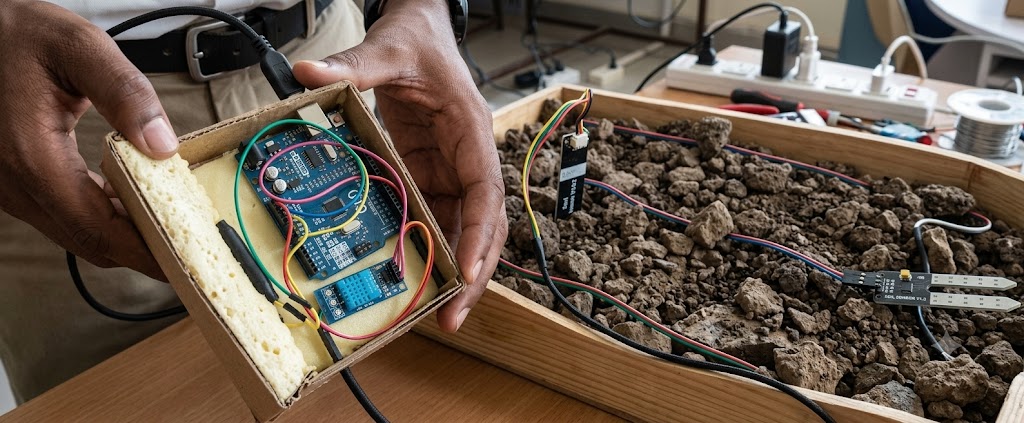
The student-led project uses automation, agriculture and STEM—Science, Technology, Engineering and Mathematics—to support the development of a climate-resilient school farm. Its goal is to ensure that crops receive water when natural rainfall becomes insufficient or unreliable.
The Challenge Beyond the School Garden
Unpredictable rainfall and prolonged dry conditions have made it difficult for the school farm to produce reliable harvests.
When crops do not receive enough water, they wither, dry up or produce poor yields. The effects of these losses extend beyond the garden and directly affect the school community.
Poor harvests can lead to food shortages, smaller portions in the dining hall and, in severe situations, missed meals. The school may also be forced to purchase food from external markets at a higher cost, even when it has land that could support greater food self-sufficiency.
Instead of waiting for rainfall patterns to improve, the students began developing a technological response.
A Farm That Knows When Crops Need Water
The Smart Plant Irrigation System is designed to monitor soil conditions and supply water when crops need it.
A soil-moisture sensor checks whether the soil is sufficiently wet or becoming dry. The Arduino board processes this information and controls a water pump through a relay module.
When the soil becomes too dry, the system can activate the pump and deliver water to the crops. Once the required moisture level is reached, irrigation can be stopped, helping to reduce unnecessary water use.
This approach replaces guesswork with real-time information and introduces the school to the principles of precision agriculture.
The system is intended to act as a climate-resilience tool that supports the farm whenever natural rainfall is inadequate. It may also serve as a practical model that surrounding farmers can study and adapt to their own gardens.
Technology Behind the Innovation
The student innovators developed the prototype using accessible electronic and irrigation components, including:
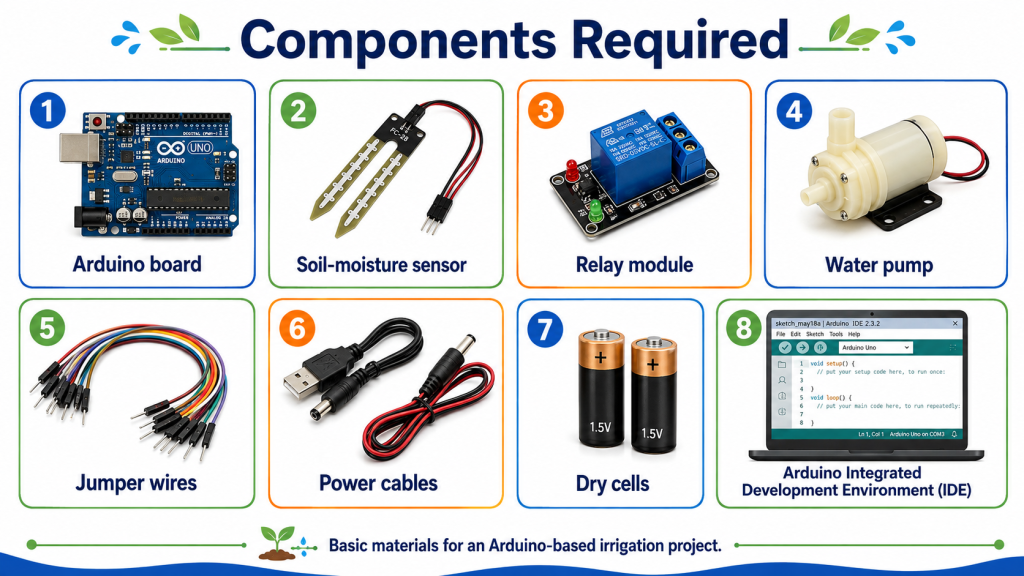
Each component performs an important role in sensing soil conditions, processing information and controlling the movement of water.
The Arduino board acts as the system’s control centre, while the soil sensor collects information from the garden. The relay allows the low-power electronic circuit to control the water pump safely.
Through the Arduino programming environment, students can write and test the instructions that determine when the pump should switch on or off.
Connecting Agriculture and Computer Science
The project demonstrates that agriculture and computer science do not have to be taught only as separate theoretical subjects.
Students participating in the project gain practical experience in:
- Arduino programming
- Physical computing
- Electronic connections
- Soil-moisture monitoring
- Automated system design
- Sustainable agriculture
- Problem-solving
- Teamwork
- Prototype testing
By applying classroom knowledge to an actual challenge facing their school, the learners are developing skills that are relevant to agriculture, engineering, environmental management and the modern digital economy.
Growing Food and Protecting Learning
The potential benefits of the Smart Plant Irrigation System extend across the entire school.
More Reliable Harvests
Regular and timely irrigation can help crops survive dry periods and produce more dependable yields.
Improved Food Security
Better harvests could reduce the food deficit experienced during difficult school terms and help ensure that learners receive more reliable meals.
Reduced Food Expenditure
Producing more food on the school farm could reduce the amount of money spent purchasing food from external suppliers.
Efficient Water Use
Because irrigation is guided by information from the soil sensor, water can be supplied according to the condition of the soil instead of being applied randomly.
Practical STEM Education
The project gives students an opportunity to learn programming, electronics and agricultural technology through hands-on experimentation.
A Model for Local Farmers
With further development, the system could provide a practical example of affordable smart agriculture that can be adapted by farmers experiencing similar rainfall challenges.
Innovation Supporting Sustainable Development
The project directly contributes to important Sustainable Development Goals.
SDG 2: Zero Hunger
By supporting more consistent food production, the irrigation system responds to food shortages associated with poor harvests and unreliable rainfall.
SDG 4: Quality Education
The project moves learning beyond theory by giving students practical experience in Arduino programming, automation, agriculture and physical computing.
It also shows how education can empower learners to develop solutions that improve life within their own communities.
From a Student Prototype to a Climate-Smart School Farm
The Smart Plant Irrigation System represents more than an electronics project. It is a response to the connection between climate change, school agriculture, food availability and learner wellbeing.
With continued mentorship and support, the students can expand the prototype by introducing a larger water reservoir, solar power, several soil sensors, improved irrigation pipes and a digital display showing moisture levels.
Future versions could also record soil-moisture information over time, send alerts to the farm manager and control irrigation across different sections of the school garden.
Through this innovation, the students of Maruzi Seed Secondary School are demonstrating that young people do not have to remain passive when their communities face serious challenges.
When rainfall becomes unreliable, knowledge, creativity and technology can keep both crops and hope growing.


Leave a Reply
You must be logged in to post a comment.